



Up to 100,000 cyclists a day left unprotected - railway station bike thefts now effectively ignored
October 6, 2025
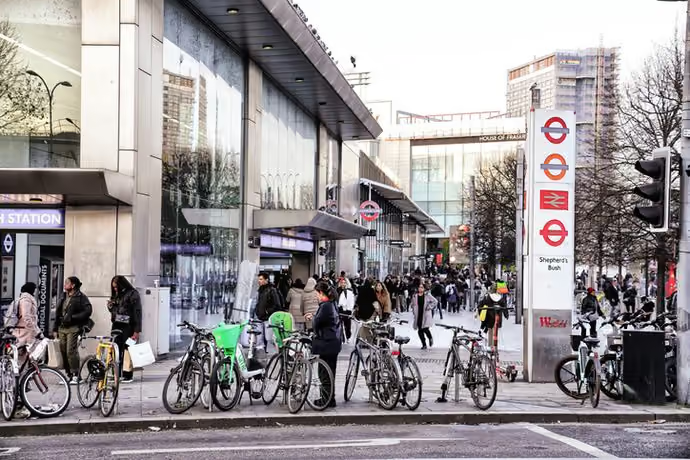
Every weekday, an estimated 85,000 to 110,000 people lock their bikes at UK railway stations. The vast majority leave their bikes for longer than two hours while they travel and work. Under British Transport Police policy, if any one of those bikes is stolen, their case will not be investigated. No CCTV review. No follow-up.
Commuter cyclists are, in effect, being told: if your bike is taken, you’re on your own.
And it gets worse. Even those who lock up for shorter periods may still be excluded from help - because the BTP also won’t investigate thefts of bikes worth under £200.
Older bikes, second-hand bikes, student bikes and budget commuters are written off before the lock has even been cut.
.avif)
Responding to criticism, the British Transport Police said it must apply “a test of proportionality” when deciding which bike thefts to investigate, emphasising that officers will not review CCTV if the bike was left for more than two hours. The force argues that the time spent on such cases takes resources away from “crimes which cause the most harm.”
Between 2021 and 2023, over 14,000 bikes were reported stolen from outside stations. Under the current approach, the vast majority of those cases would now be dismissed at the outset.
In truth, the BTP’s stance only formalises what cyclists experience elsewhere - bike theft is already a low-risk, high-reward crime, and follow-up is rare even when it’s reported.
And yet...ETA still covers bikes for a full 24 hours
ETA Cycle Insurance covers bikes locked at railway stations for up to 24 hours at a time, as long as they’re secured through the frame to an immovable object with the appropriate Sold Secure-rated lock.
While policing may have stepped back, we still treat station parking as a normal, legitimate part of daily life - not an inconvenience to be ignored.
Designing for bike theft
In the Netherlands, bike theft is treated as something to manage rather than a reason to stop cycling. Per capita, theft rates are far higher than in the UK - a difference largely down to exposure: millions of Dutch cyclists leave their bikes in public places daily, especially at stations. Many use simple, practical town bikes for these trips, which lowers the cost and resale value, but it’s the sheer number in circulation - not a casual attitude - that drives theft rates up.
To cope with that reality, stations provide staffed or access-controlled parking hubs, often free for the first 24 hours, and it’s normal to double-lock a bike using a built-in frame lock and a second lock to something fixed.
Cities also operate central depots to reunite owners with recovered bikes, making resale riskier. The approach assumes bikes will be parked all day - and designs prevention and recovery around that fact.
A system that leaves cyclists uncovered — unless they’re insured
The Netherlands doesn’t have less bike theft — per capita it’s significantly higher than in the UK. The difference is that Dutch rail and city authorities design for that reality: they provide staffed or access-controlled parking, expect bikes to be left for many hours at a time, encourage double-locking and operate recovery depots so stolen bikes can be traced or reclaimed.
In Britain, the effect is very different. By choosing not to investigate thefts where a bike has been left for more than two hours - a period shorter than many people are away - and by disregarding lower-value bikes altogether, the system leaves most station cyclists without meaningful follow-up if their bike disappears. The physical infrastructure may exist in the form of racks, compounds and CCTV, but the enforcement behind it no longer reflects how people actually use those spaces.
Until that gap is addressed, riders are left to protect themselves - which is why insurance that covers bikes at stations for up to 24 hours, like ETA’s, has become essential.
Cycle Rescue is free with ETA bicycle insurance
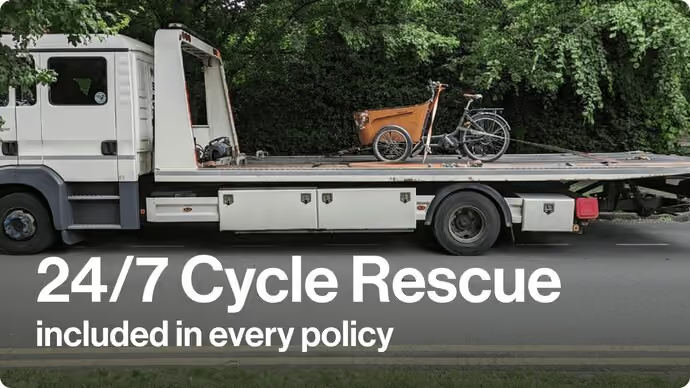
If you suffer a breakdown (including punctures, or even a flat e-bike battery) while out cycling, our 24-hour Cycle Rescue team can arrange transport for you and your bicycle to a safe location. Buy as a standalone service, or get it included for free with ETA cycle insurance, along with:
• Theft, accidental damage & vandalism
• E-bike battery theft cover
• Cycle Rescue
• No devaluation of your bike over time
• £2m third party PLUS £20,000 personal accident cover
• Shed and garage storage
• Low standard excess of 5% (£50 minimum)
{{cta-ebike}}
The ethical choice
The ETA was established in 1990 as an ethical provider of green, reliable travel services. Over 35 years on, we continue to offer cycle insurance , breakdown cover and mobility scooter insurance while putting concern for the environment at the heart of all we do.
The Good Shopping Guide judges us to be the UK's most ethical provider.
Information correct at time of publication.
Leave us a comment
