





“Not in a class” mobility scooters: why the rules can be unclear
February 16, 2026
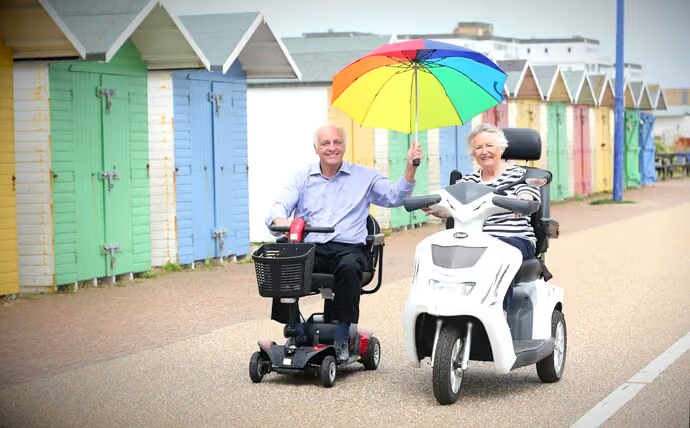
Most people use a mobility scooter that is categorised as either class 2 or class 3. However, if you think your scooter might be heavier, faster or wider than a class 3 it's very important to understand what is meant by "not in a class".
What does it mean if a mobility scooter is not in a class?
Class 2 scooters are limited to 4mph and are intended for use on pavements.
Class 3 scooters are limited to 8mph and can be used on the road. They have to be registered with DVLA and have size and weight limits. A class 3 mobilty scooter cannot weigh more than 150kg (200kg if you need to carry extra equipment), and they cannot be wider than 85cm.
If your scooter exceeds any of these limits, it is “not in a class”, and the rules and regulations become more complex.
How do I register a mobilty scooter that is faster, heavier or wider than a class 3?
In law, both class 2 and class 3 mobility scooters are described by the rather antiquated term “invalid carriage”.
A form on the .gov website titled Registering a mobility scooter (INF304) states that “if your vehicle is ‘not in a class’ you will need to tax and register it as either a quadricycle, tricycle, or motor car.” However, when we contacted DVLA, we were told that applications to register a mobility scooter that is not in a class are dealt with on a case by case basis. In practice, this seems to suggest that despite the wording on INF304, following the assessment by DVLA, such a vehicle may be recieve a categorissation of invalid carriage, albeit one that is subject to different rule and regulations to a class 3.
We have written to DVLA to ask for clarification, because we think the rules that define mobility scooters that are not in a class are hard to understand.
It's important because the stakes are high. You need a driving licence to use a mobility scooter that is not in a class, and while insurance is not mandatory unless it weighs more than 254kg, you are subject to the same rules as drivers if you cause a crash. That can mean penalty points, a fine, or in the most serious cases a prison sentence.
Do mobility scooter rules and regulations need updating?
Yes, we think they do. A good start would be retiring the term "invalid carriage". Another improvement would be making provision for tandem mobility scooters, which at present are not legal to use on the road or on pavements. And as outlined above, the rules for mobility scooters that are not in a class could be much clearer.
This is a potential problem for anyone who discovers they have a mobility scooter sold as class 3, but which turns out to be too fast or too heavy to qualify. We know of at least one case where the issue only came to light after a collision, leaving the owner in a legally and financially precarious situation.
Hopefully things might be about to change for the better. The government has announced a full review of the law that makes tandem mobility scooters illegal on pavements and roads.

For the first time, the Department for Transport is asking the public whether two-seat mobility scooters should be permitted, as part of a wider consultation on how powered mobility devices are classified and where they can be used. The consultation also raises questions about whether mobility scooters should be allowed to use cycle lanes – currently they are not – and whether the outdated “invalid carriage” definition should finally be replaced with terminology that reflects modern technology and the lived experience of disabled people and their carers.
The consultation is open to anyone until 31 March 2026. If a tandem mobility scooter would benefit you or someone you look after, you can submit a response here.
Insurance for mobility scooters
Insurance for class 2 and class 3 mobility scooters is not mandatory, but there are plenty of reasons to consider it. As well as covering theft, accidental damage and third party liability, some policies include extras such as breakdown recovery and puncture cover at no extra cost.
If your mobility scooter is not in a class, insurance is not mandatory unless it weighs more than 254kg, or its speed and size mean it is categorised as a quadricycle.
{{cta-mobility}}
Information correct at time of publication.
Leave us a comment
