




UK e-bike battery fires: the risks, the myths, and the tech fix
September 4, 2025
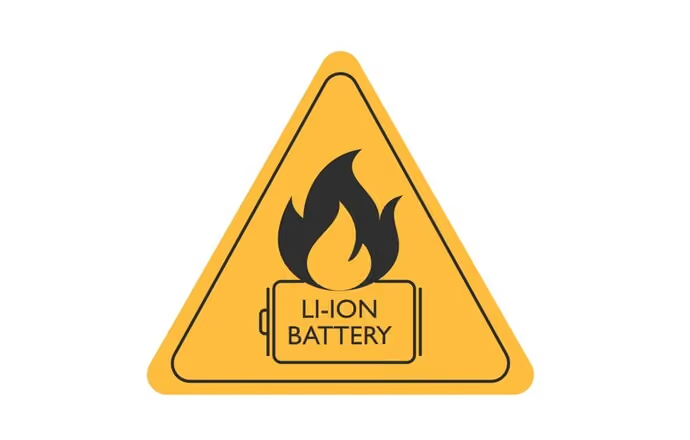
It’s hard to miss the headlines. Over recent years, the media has seized on e-bike and e-scooter battery fires with all the nuance of a Victorian penny dreadful. Cue landlords, insurers, and building managers across the country scrambling to update tenancy agreements.
Some landlords have taken a cautious approach: tenancy agreements increasingly include clauses that prohibit e-bikes and e-scooters without landlord permission, often accompanied by safety conditions tenants must follow if permission is granted. In more stringent cases, landlords recommend or impose a blanket ban on charging e-bikes inside the property, reflecting concerns over significant fire risks.
The trouble is, the perception of risk is often out of step with reality - and that matters when it undermines confidence in the cheapest, healthiest and greenest form of EV personal transport.
Lithium-ion batteries are hardly exotic. They power your phone, your laptop, maybe even your cordless vacuum cleaner. We plug them in to charge without a second thought. The difference with e-bikes is less about the chemistry and more about the quality control.
In the UK, most serious battery fires linked to e-bikes can be traced back to cheap batteries and specifically their substandard BMS (battery management system), which may not effectively monitor voltage, temperature, or current. This can lead to overcharging, overheating, or thermal runaway, significantly increasing the risk of fire.
Another risk is the use of mismatched or counterfeit chargers, which may deliver too much power or lack cut-off protection.
Address these issues, and the fire risk drops off a cliff. We’re talking about a fixable problem, not an inherent flaw in the idea of putting a battery in a bike.
A tech solution to e-bike fires?
BatteryIQ is developing technology that tracks battery health in real time and feeds safety data to manufacturers, insurers, and (potentially) landlords - allowing issues to be dealt with before they become emergencies.
The software can detect damage, overheating, or unsafe charging patterns.
For landlords, this could be transformative: instead of banning all indoor charging, they could simply require that tenants’ batteries be monitored by BatteryIQ - perhaps in tandem with an accreditation marque for e-bikes similar to the farm-assured Red Tractor. For tenants, it’s a ticket to keep riding without the constant fear of new rules pulling the plug.
No one is saying ignore the risk. Lithium-ion fires are fast, hot, and unforgiving. But it’s equally true that most are avoidable, and avoiding them is relatively straightforward when you focus on the real causes.
Rather than reaching for the blunt instrument of a ban, we could take a scalpel to the problem: insist on verified batteries and chargers, educate on safe charging practices, and use emerging tech to monitor and manage risks in real time.
The result? Safer buildings, happier tenants, and a transport revolution that isn’t derailed by the fear of a problem we already know how to solve.
e-bike fires - know the risks
With an estimated two million e-bikes in the UK, and sales on the up, battery fires are on the increase. However, they occur at a rate of less than one per day.
To put that in perspective, 100,000 cars go up in flames every year resulting in the death of around 100 people. That's nearly 300 vehicles fires every day. In other words, a car is twice as likely to catch fire as an e-bike.
However, given electric bicycles are most often charged inside the home, it's a risk worth guarding against - especially when the safeguards are so easy to follow.
{{cta-ebike}}

E-bike fire risk advice
The greatest risk of e-bike fires stems from poor quality electric bicycles, chargers and batteries sold by disreputable dealers. E-bike conversion kits that have not been installed by a professional, and mismatching batteries and chargers also increase any risk.
The UK government recommends these five steps when buying and charging your e-bike:
- Only buy an e-bike, e-scooter, charger or battery from a known seller and check any product reviews
- Always read and follow the manufacturer’s instructions for charging and using e-bikes or e-scooters
- Not all e-bike or e-scooter batteries and chargers are compatible or safe when used together. Check and only use the manufacturer’s recommended battery or charger
- Always charge in a safe place without blocking exits and always unplug your charger when you have finished charging
- Never attempt to modify or tamper with your battery
E-bike fires: Existential threat or moral panic?
Unlike car fires, e-bikes pose a risk inside the home, but what about chip pan fires? These occur at a rate of 1,000 a month and kill almost one person every week. E-bike battery safety/regulation is important, but context is everything.

Lithium ion battery safety
Most of us already use lithium ion batteries in devices such mobile phones, laptops and cordless tools, and do so safely. Most of the fire risk occurs with products that don't conform with the CE or UKCA mark, or mixing and matching batteries and chargers. E-bike are no different.
Before a lithium-ion battery catches fire, there may be warning signs. Stop using or charging your battery immediately if you notice any of the following:
- Excessive heat, or smoke
- Swelling or leaks
- Hissing or cracking sound
- A strong or unusual smell
- A sudden deterioration in performance
If the charger or battery starts smoking or catches fire, raise the alarm, get out, stay out and call 999 immediately. Remember to report your faulty charger or battery to the Citizens Advice Consumer Service.
Charging e-bike batteries
The fire service has the following advice on how to charge e-bike batteries:
- Don’t charge e-bikes and e-scooters in bedrooms or where escape routes can be blocked – for example, hallways.
- Don’t leave your battery charging unattended, when you are out or while you are asleep.
- Don’t cover chargers or battery packs when charging
- Don’t overload sockets or use inappropriate extension leads
- Don’t charge or store batteries in direct sunlight or in hot locations (above 45⁰C)
- Don’t charge batteries close to combustible materials or hazardous substances.
- Always unplug your charger when you have finished charging
- If your battery can be removed from your e-bike or e-scooter and charged separately, it should be charged on a hard flat surface where heat can disperse and in area with good ventilation.
{{cta-ebike}}
The ethical choice
The ETA was established in 1990 as an ethical provider of green, reliable travel services. Over 35 years on, we continue to offer cycle insurance , breakdown cover and mobility scooter insurance while putting concern for the environment at the heart of all we do.
The Good Shopping Guide judges us to be the UK's most ethical provider.
Information correct at time of publication.
Leave us a comment
