



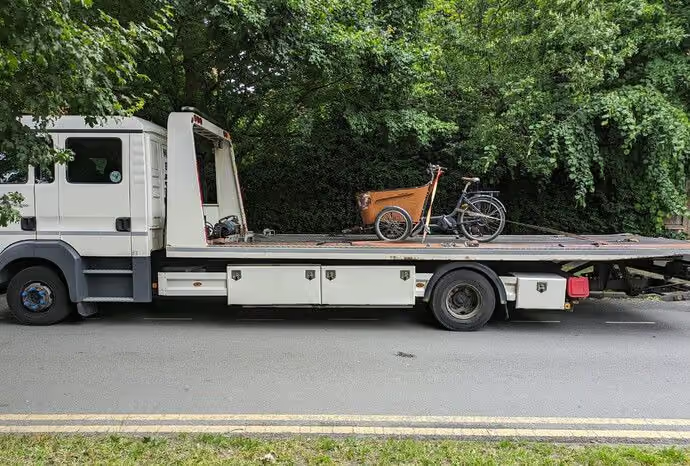
Too close for comfort: why dangerous overtakes drive people off bikes
September 30, 2025
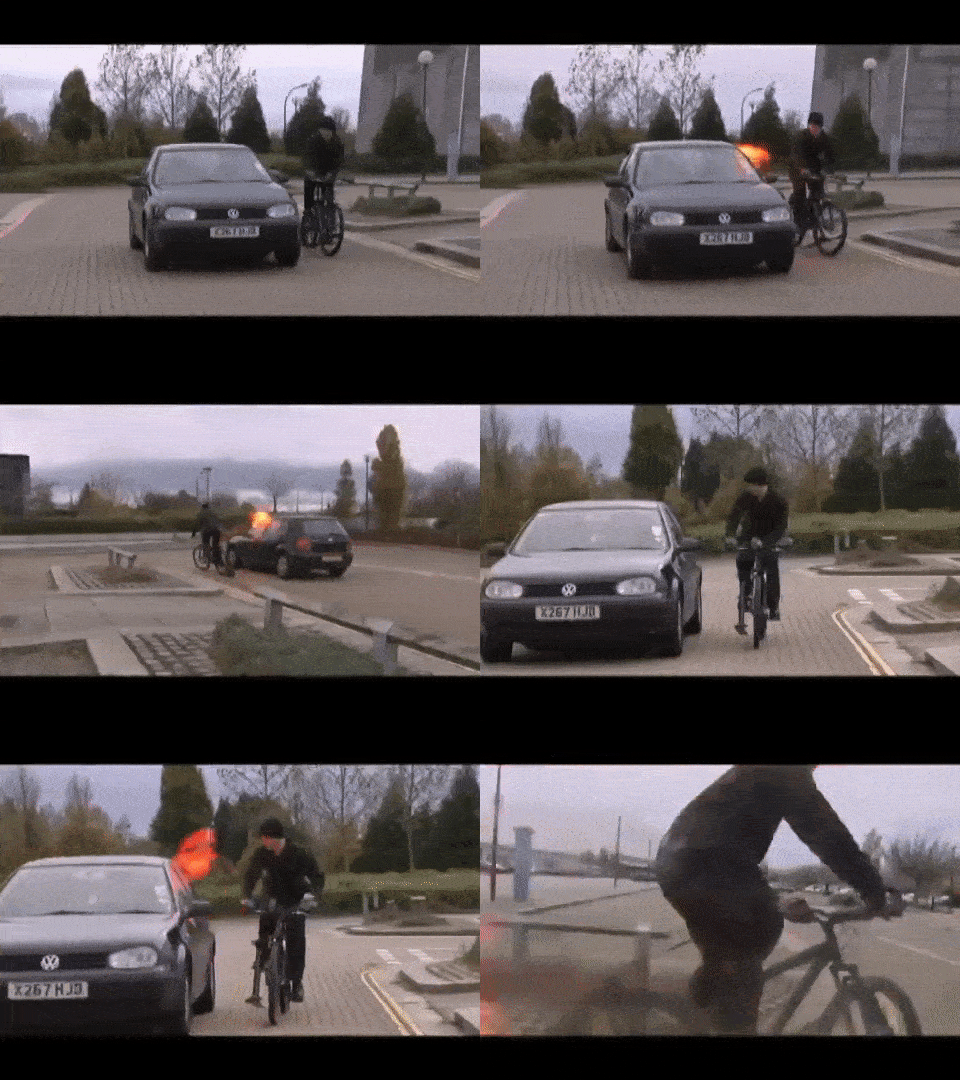
Ask any cyclist what they fear most and chances are they’ll describe the same moment: a motorist overtaking too close, road space narrowing, the certainty that there is no space to escape to.
When we polled 800 cyclists, close overtakes topped the list of grumbles, eclipsing potholes and poor weather. The reason is obvious: while drizzle or cracked asphalt may dampen a ride, a close pass is at best intimidating, at worst life-threatening.
Why do close passes happen? The causes usually fall into two categories: drivers who misjudge the space required, and those who know the risk but overtake anyway. Beneath both is a deeper issue: the way drivers think about cyclists, and how those attitudes shape their behaviour.
A recent study by researchers at Aston University asked almost 300 UK drivers to watch video clips of close passes submitted by cyclists to an English police force.
Participants were then asked to apportion responsibility between the rider and the driver. The pattern was stark. People who also ride bikes tended to see the driver as responsible; those who never cycle were more likely to blame the cyclist. Drivers who admitted to using their vehicles to vent anger - tailgating, revving, swerving - were also more likely to dismiss the risk and blame the rider. Knowledge made a difference too: drivers who understood the Highway Code guidance on cyclist road positioning were less inclined to hold the rider responsible.
.avif)
This knowledge gap matters. A study in Australia led by public health researcher Chris Rissel showed that drivers with negative attitudes towards cyclists often had weaker knowledge of road rules. Later work here in Britain found that drivers frequently felt pressured by vehicles following behind them, and that this social pressure was a key factor in risky overtakes.
Drivers who feel hurried by a queue of traffic are more likely to squeeze past a cyclist ahead. Many riders recognise the pattern instinctively: the bigger the queue building up behind, the closer the pass they experience in front.
What the rules say
Since January 2022, the Highway Code has been clear: leave at least 1.5 metres when overtaking a cyclist at up to 30 mph, and give more room at higher speeds. The “hierarchy of road users” also sets out a simple principle - those who can do the greatest harm carry the greatest responsibility. None of this is radical; it is about giving people on bikes the space they need to stay safe.
Even when they don’t end in a crash, close passes damage confidence. They change the routes riders choose, put people off cycling altogether for some trips, and - for those watching from the pavement - reinforce the idea that cycling is “for the brave”. That is a public-health issue as much as a transport one. Cycling offers cleaner air, lower congestion and healthier bodies. If close passes are the price of admission, we all lose.
{{cta-cycling}}
Enforcement that changes behaviour
One of the most promising UK responses has been Operation Close Pass. Pioneered by West Midlands Police and now used elsewhere, it relies on plain-clothes officers on bikes with cameras. Drivers who pass too close are stopped and either educated or prosecuted.
The results have been significant. In the West Midlands, the number of cyclists killed or seriously injured fell by around 20% after the first year. Almost 200 drivers were pulled over in person, 13 were prosecuted for especially poor driving, and hundreds more were sanctioned using footage submitted by cyclists. “We’ve seen reports of close passes halve in the West Midlands since we started the project,” said PC Mark Hodson of the force’s traffic unit. “To see a fall of 20% in the number of serious collisions involving cyclists is incredible, especially against a backdrop of increasing numbers of people cycling on our roads.”
The close pass thrives on misconceptions: that cyclists belong in the gutter; that riding centrally is “arrogant”; that a cyclist’s safety can be compromised to avoid delaying traffic.
- Teach what safe looks like. Driver education should cover cyclist road positioning and overtaking distances in detail, as essential risk management.
- Design for space. Road layouts that calm speeds effectively remove risk.
- Scale up enforcement. Close-pass operations are relatively cheap, highly visible and popular with those they protect. Pair them with public campaigns that show what 1.5 metres looks like from the driver’s seat.
- Treat aggression as a red flag. The evidence is clear: drivers who use their cars to express anger downplay the danger they create. Sentencing, insurance premiums and interventions should reflect this.
Close passes are not an inevitable hazard of “sharing the road”. They are a solvable behaviour, rooted in knowledge gaps, impatience and brittle attitudes. The fix is straightforward: clear rules, streets that support them, visible enforcement, and a culture that treats a person on a bike as exactly that - a person.
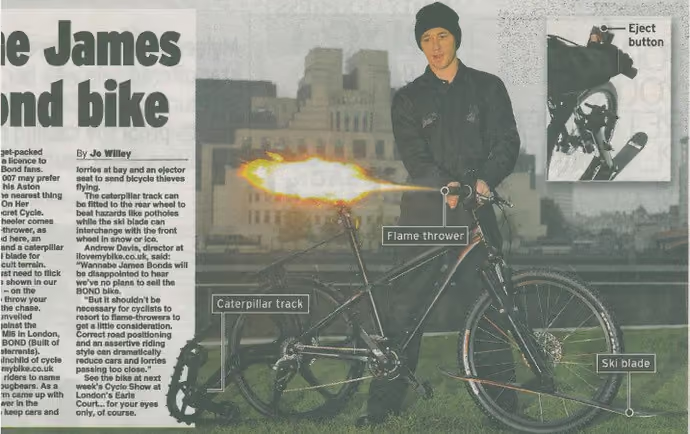
At ETA we once created our own tongue-in-cheek response to the problem: the BOND bike, a spoof machine kitted out with a flamethrower to deal with close passes.
The idea was a parody - a James Bond fantasy applied to the daily reality of cycling in Britain. The humour masked a serious point: people on bikes shouldn’t need Q's gadgetry to feel safe on ordinary roads.
What we need, and deserve, is something much simpler - space.
Cycle Rescue is free with ETA bicycle insurance
If you suffer a breakdown (including punctures, or even a flat e-bike battery) while out cycling, our 24-hour Cycle Rescue team can arrange transport for you and your bicycle to a safe location. Buy as a standalone service, or get it included for free with ETA cycle insurance, along with:
• Theft, accidental damage & vandalism
• E-bike battery theft cover
• Cycle Rescue
• No devaluation of your bike over time
• £2m third party PLUS £20,000 personal accident cover
• Shed and garage storage
• Low standard excess of 5% (£50 minimum)
{{cta-ebike}}
The ethical choice
The ETA was established in 1990 as an ethical provider of green, reliable travel services. Over 35 years on, we continue to offer cycle insurance , breakdown cover and mobility scooter insurance while putting concern for the environment at the heart of all we do.
The Good Shopping Guide judges us to be the UK's most ethical provider.
Information correct at time of publication.
Leave us a comment
