





The hidden afterlife of e-bike batteries
October 16, 2025

Few e-bike buyers stop to think about what will happen to the battery when it eventually dies – little different, in truth, to most of the things we buy in our consumer society. Yet the battery is both the most expensive and the most environmentally costly part of an e-bike.
Brighton-based design studio Gomi has found a way to give those batteries a second life. Its power banks are made entirely from repurposed e-bike cells – batteries that would otherwise be waste, turned into sleek, repairable devices designed to last. It's a clever and colourful way to address a potential weak spot in e-bike sustainability.
What happens to old batteries?
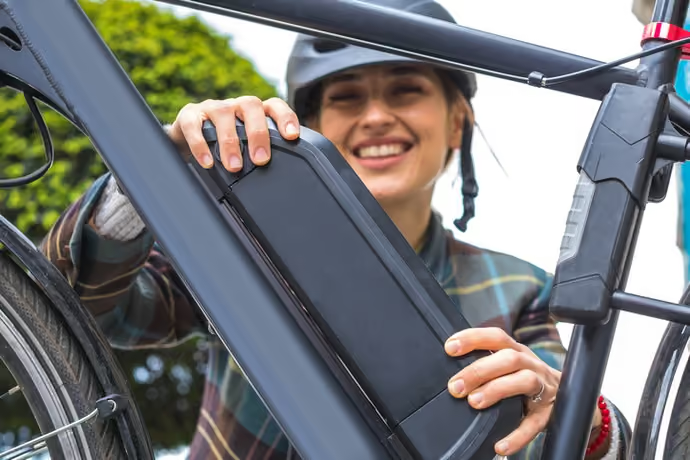
Lithium-ion batteries are resource-intensive to produce, containing cobalt, nickel and lithium. Most will last between three and five years, or around 500–1,000 charge cycles, before their range begins to fall away. When they do need replacing, the bill can run to £400–£800, making them one of the priciest parts of an e-bike.
The good news is that simple care makes a difference: avoiding running the battery to completely empty, charging little and often, and storing batteries out of extreme heat or cold can all extend their useful life.
Recycling is the obvious answer, though the UK is only now building up the necessary infrastructure. Many council recycling centres accept e-bike batteries, as do larger retailers such as Halfords and Currys. Specialist firms are also beginning to recover the valuable metals inside. The system is growing, but it’s far from universal.
Until it matures, re-use provides a useful bridge. A pack too weak for the heavy loads of an e-bike can still contain plenty of healthy cells. Gomi harvests those, tests them for safety, and builds them into new power banks and speakers. Unlike most consumer tech, its products are designed to be repaired and upgraded, stretching their lifespan further.
e-bike battery: safety and second life
Damaged lithium-ion cells can be dangerous, and concerns over fire risk are well founded. The difference here is that only cells that pass safety and performance checks make it into new products. The rest are rejected and sent for recycling. Repurposing in this way keeps working cells in circulation for longer, while the most degraded are properly disposed of.
Strictly speaking, this isn’t yet a circular economy. To close the loop, cells would need to be recycled at the end of their second life and the raw materials fed back into new e-bike batteries. Still, extending use in this way cuts the carbon footprint of every pack and buys time until large-scale recycling is fully established.
Help! My e-bike battery has failed
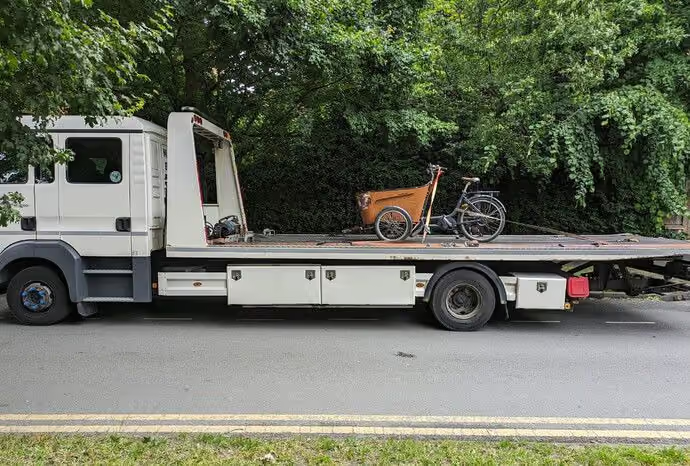
For riders, the other part of the picture is what happens if a battery fails mid-journey. ETA’s Cycle Rescue covers e-bikes as well as conventional cycles, including recovery for failed or flat batteries.
{{cta-ebike}}
The ethical choice
The ETA was established in 1990 as an ethical provider of green, reliable travel services. Over 35 years on, we continue to offer cycle insurance , breakdown cover and mobility scooter insurance while putting concern for the environment at the heart of all we do.
The Good Shopping Guide judges us to be the UK's most ethical provider.
Information correct at time of publication.
Leave us a comment
