



Norway’s EV boom shows what happens when driving feels free
July 30, 2025
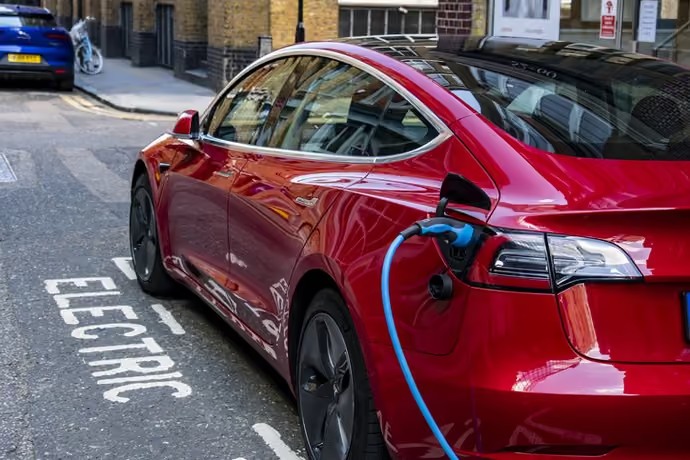
There’s a lot to admire about Norway’s approach to electric vehicles. The country has cleaned up its new car market faster than anyone - last year, almost 9 in 10 newly registered passenger cars in Norway were fully electric. Tailpipe emissions? Gone. City air? Much cleaner. But there’s a less celebrated side to this success story - one that raises important questions about how we encourage cleaner transport without accidentally making traffic worse.
A new study from Norway’s Department of Economics reveals an unintended consequence of the EV boom: people are driving more. Not just replacing internal combustion engine trips with electric ones, but actually making more journeys overall - and fewer of them on foot, by bike or by bus.
The researchers looked at households across Norway - the world’s most mature electric vehicle market - and found that EV ownership leads to a 10–20% rise in car trips.
It means EV owners are driving more than their petrol-powered counterparts, and some of those extra trips are coming directly at the expense of public transport, walking and cycling.
Driving an EV is cheaper per kilometre than driving a petrol or diesel car - especially in Norway, where drivers of electric cars often enjoy toll exemptions and reduced parking charges. When the marginal cost of driving falls, people tend to drive more. In areas where EV drivers don’t have to pay tolls, the study found, they make “substantially more” car trips than those who do. When driving feels free, people act accordingly.
It’s a powerful reminder that incentives and disincentives matter - not just at the point of purchase, but at the point of use.
And that’s where things get tricky. Because while EVs cut tailpipe emissions, they don’t magic away congestion, nor the tyre-derived particles that pollute our air. Traffic noise, road danger and the sheer amount of space that cars consume remain remarkably similar whether you’re in a Tesla or a Land Rover. Add more driving into the mix - even if it’s electric - and you risk a rise in these harms.
It’s not just about emissions, then. It’s about how we use our streets. If EV incentives are pulling people out of buses and off bikes, we may be replacing one set of problems with another.
Norway’s experience should be a warning. The benefits of EVs are real and important. But they don’t exist in a vacuum. If we focus solely on decarbonising the car fleet without rethinking how we price road use or support alternatives, we may end up with cleaner traffic - but more of it.
This is not just a Norwegian problem. In the UK, electric vehicles are also exempt from road tax and, for now, the London Congestion Charge. That changes in 2026, when the city plans to scrap the 100% discount and reintroduce a full daily fee for EVs. The Ultra Low Emission Zone (ULEZ) will still reward zero-emission vehicles, but the Congestion Charge is set to treat them the same as any other car. It’s a subtle but significant shift in thinking: clean doesn’t mean consequence-free.
The road ahead: pay-as-you-go driving
If cheaper-per‑mile driving nudges us into more driving, the fix isn’t to row back on electrification - it’s to manage demand fairly. That means modern road pricing: charges that reflect when and where road space is scarce, while protecting those with the least choice. Politically, though, Westminster is still skittish.
The Conservatives went into the 2024 election promising to stop road pricing altogether, including a ban on mayors and councils introducing pay‑per‑mile schemes. Labour, now in government, has repeatedly said it has no plans for national pay‑per‑mile charging, despite growing fiscal pressures as fuel duty erodes. The Liberal Democrats’ 2024 manifesto focused on cheaper EV charging and better public transport rather than a national road‑pricing plan, while the Greens are the outliers, explicitly favouring the introduction of privacy‑protecting road pricing alongside restoring the fuel‑duty escalator.
For now, the real movement is local. London will end the 100% Congestion Charge discount for EVs on 25 December 2025, and City Hall is consulting on the next step: lifting the daily charge to £18 from January 2026 and replacing the blanket EV free‑pass with a smaller, targeted discount - an explicit nod to the idea that clean vehicles still create congestion if they’re cheap to drive at busy times.
Whatever happens nationally, this is the direction of travel cities will have to take if they want buses to move, streets to breathe, and EVs to help rather than hinder that shift.
Cycle Rescue is free with ETA bicycle insurance
If you suffer a breakdown (including punctures, or even a flat e-bike battery) while out cycling, our 24-hour Cycle Rescue team is on hand to arrange transport for you and your bicycle to a safe location. The service is included for free with ETA cycle insurance, along with:
• Theft, accidental damage & vandalism
• E-bike battery theft cover
• Cycle Rescue
• No devaluation of your bike over time
• £2m third party PLUS £20,000 personal accident cover
• Shed and garage storage
• Low standard excess of 5% (£50 minimum)

{{cta-cycling}}
The ethical choice
The ETA was established in 1990 as an ethical provider of green, reliable travel services. Over 30 years on, we continue to offer cycle insurance , breakdown cover and mobility scooter insurance while putting concern for the environment at the heart of all we do.
The Good Shopping Guide judges us to be the UK's most ethical provider.
Information correct at time of publication.
Leave us a comment
