





No cable, no problem: how e-bikes are quietly solving the charging puzzle
July 21, 2025
As the UK government sticks to its 2035 target to end the sale of new petrol and diesel cars, a looming question remains unanswered: how will the 9 million households without a driveway charge their electric vehicles?
While ministers scratch their heads over kerbside charging, and councils face backlash over pavement clutter caused by cables trailing across public footways, another form of electric transport is quietly getting on with it - and solving the problem in the process.
Enter the humble e-bike.
Unlike electric cars, which require dedicated charging points or inconvenient roadside infrastructure, e-bikes have always had a head start. Most batteries are light enough to unclip and plug into an ordinary socket indoors - no kerbside charger required. But the tech hasn’t stood still.
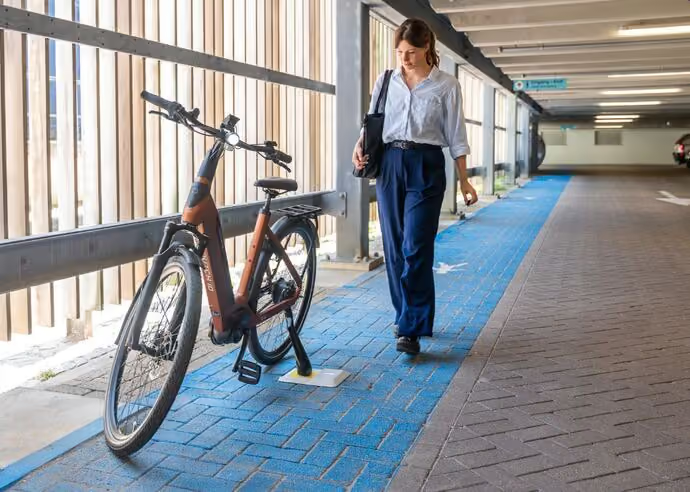
A Dutch company called Tiler is developing a wireless e-bike charging system that promises to make charging even simpler. Think of it like placing your phone on a charging pad - except it’s your e-bike, and the charging pad is a small tile on the ground.
.avif)
The Tiler system works using a conductive kickstand that draws power from the tile beneath it. Over 200 units have already been trialled in the Netherlands, Germany and Ireland, delivering more than 300,000 km of pedal-assisted riding.
While the pilot projects have focused on adapted fleet bikes, Tiler claims its retrofit kit is compatible with 80% of the e-bike market, including Bosch, Shimano, Bafang and Yamaha systems. The setup promises a 150W output - enough to fully charge a standard 500Wh battery in three to four hours.
Multiple tiles can be linked together to support fleet charging for e-bike rental schemes or businesses, but they’re also compact and subtle enough to be used in public space - without adding to the clutter already clogging Britain’s pavements.
{{cta-ebike}}
With crowdfunding underway, the retail price is expected to be around €225. The company has already secured €2.9 million in funding, including development subsidies, and hopes to roll out the system to consumers and fleet operators soon.
As cities wrestle with the infrastructure challenges of electrifying transport, innovations like Tiler’s hint at a future that doesn’t rely on kerbside chaos or tangled cables. In the race to decarbonise, e-bikes are quietly - and conveniently - winning the charge.
Pavement trip hazard: the legal grey area of EV charging cables
In contrast to the cable-free promise of wireless e-bike charging, the UK’s current approach to electric vehicle charging is tangled - literally. With no national legislation explicitly governing the use of EV charging cables trailing across pavements, the legal framework relies on a patchwork of local policies and general provisions in the Highways Act 1980.
While some councils permit trailing cables under strict conditions, such as protective covers, others ban them outright due to safety and accessibility concerns. The Equality Act 2010 also comes into play, with local authorities having a duty to ensure pavements remain accessible to disabled people.
The result? A postcode lottery of EV charging rules, and pavements cluttered with ad hoc charging setups - highlighting just how seamlessly e-bikes sidestep a growing urban headache.
While you’re here…
No matter what you ride - e-bike, folder, cargo bike, MTB, road bike, hybrid or adapted cycle - ETA Cycle Insurance has you covered. If your bike’s stolen, damaged, or breaks down mid-ride, we’re here to help. For example, every policy includes Cycle Rescue, our 24/7 breakdown service, at no extra cost.
Cycle Rescue is free with ETA bicycle insurance
If you suffer a breakdown (including punctures, or even a flat e-bike battery) while out cycling, our 24-hour Cycle Rescue team is on hand to arrange transport for you and your bicycle to a safe location. The service is included for free with ETA cycle insurance, along with:
• Theft, accidental damage & vandalism
• E-bike battery theft cover
• Cycle Rescue
• No devaluation of your bike over time
• £2m third party PLUS £20,000 personal accident cover
• Shed and garage storage
• Low standard excess of 5% (£50 minimum)

{{cta-cycling}}
The ethical choice
The ETA was established in 1990 as an ethical provider of green, reliable travel services. Over 30 years on, we continue to offer cycle insurance , breakdown cover and mobility scooter insurance while putting concern for the environment at the heart of all we do.
The Good Shopping Guide judges us to be the UK's most ethical provider.
Information correct at time of publication.
Leave us a comment
