



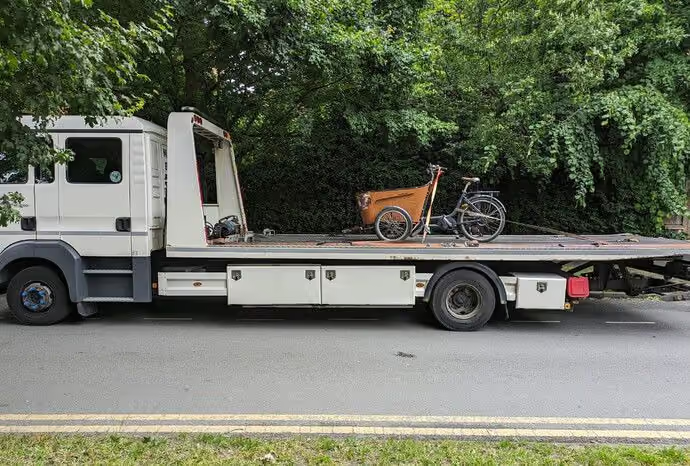
My e-bike has been seized by police – what happens next?
August 5, 2025
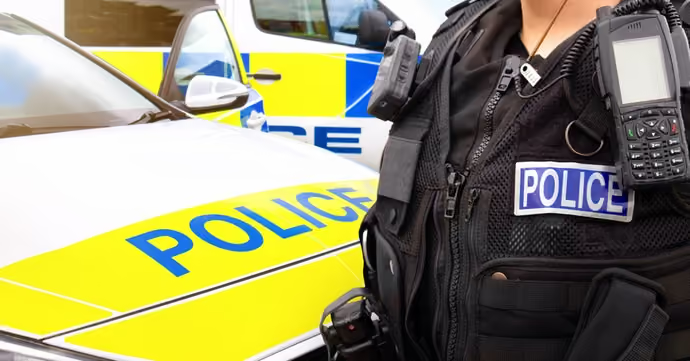
If your e-bike has been seized, what happens next depends on why it was impounded in ther first place.
1) First, figure out why it was taken
You should receive a seizure notice at the roadside or shortly after. The notice will name the power used and where your bike has been taken. The two most common types are:
A Section 59, Police Reform Act 2002 (ASB) for anti-social use, careless or inconsiderate riding on the road, or off-road riding without permission, causing (or likely to cause) alarm, distress or annoyance. Under current law, police usually issue a warning first unless that’s impracticable or a prior warning exists. It's worth noting that if the Crime and Policing Bill passes into law in its current form, the warning requirement would be removed, allowing immediate seizure.
A Section 165A, Road Traffic Act 1988 which is used when officers believe the vehicle’s being used without insurance or the correct licence.
.avif)
2) Is your bike classed as an EAPC or a motor vehicle?
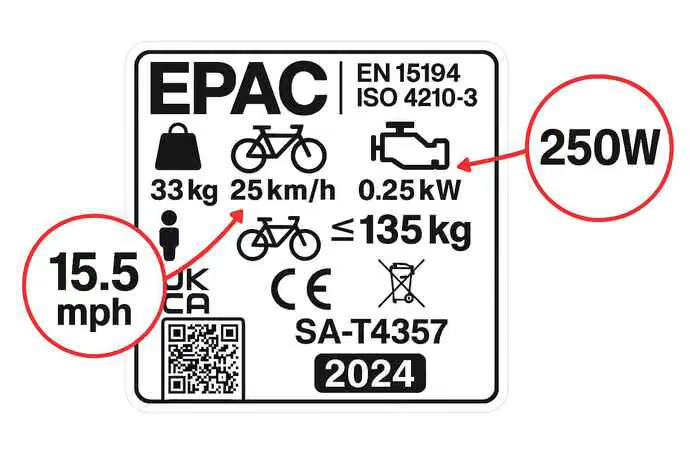
An EAPC (Electric Assist Pedal Cycle) must have pedals and a motor no bigger 250W which cuts out at 15.5 mph (25 km/h). EAPCs don’t need registration, tax or insurance. If it’s de-restricted, over-powered, or throttle-only without DVSA vehicle-approval, it’s a motor vehicle in law. That’s what many headlines refer to as an “illegal e-bike”.
▶️ Find out how to make a full-throttle e-bike legal in the UK
If your e-bike is classed as a motor vehicle and you can’t insure it, you are unlikley to have it returned to you following seizure. As well as the risk of having their e-bike crushed, offenders risk prosecution, fines, driving disqualification, or even imprisonment.
3) How to get it back (and when you can’t)
Police pounds work to a standard checklist for any seized motor vehicle. Typically you’ll need:
Photo ID and proof of ownership.
A valid driving licence.
A valid motor insurance certificate. The police will not release the bike even if you say you won’t ride on public roads and even if a recovery firm collects it. The City of London Police states this explicitly; other forces operate similarly.
Fees for removal and storage (these accrue daily).
Can I just promise to keep it on private land?
No. Police car pounds won’t hand over a motor vehicle without evidence of insurance/licence, to avoid uninsured riding the moment it leaves.
If you can’t meet the release conditions, you can disclaim the vehicle. After the retention period, it will be either crushed or auctioned.
4) How long before it’s crushed or sold?
For most seizures, forces must wait up to 14 days before disposal (or 7 working days from a claim/notice).
However, the Home Office is consulting on cutting the minimum retention to 48 hours for s.59 ASB seizures.
5) What if mine is an EAPC?
Show it meets EAPC rules: pedals, 250W motor and assistance that cuts out at 15.5 mph (25 km/h). Bring the specification sheet or manual. If it’s an EAPC and wasn’t seized for another reason, it does not need motor insurance for release.
6) Can I appeal?
There’s no formal appeal tribunal for s.59, but you can complain to the force if you believe the power was misapplied or the vehicle is an EAPC.
7) If I buy cycle insurance now, will the police release it?
No. If your bike has been classed as a motor vehicle (for example, the motor is bigger than 250 W/throttle-only without vehicle approval), the pound will only release it to someone with motor insurance, a valid licence, proof of ownership and payment of fees. Cycle insurance is not motor insurance.
▶️ Get an instant e-bike insurance quote
8) What’s the difference between cycle insurance and motor insurance?
Cycle insurance can cover bicycles and EAPCs for theft, damage and third party liability. Motor insurance is the compulsory cover for mopeds/motorcycles and any e-bike that no longer qualifies as an EAPC.
{{cta-ebike}}
9) Can I just promise to ride it on private land ?
If an e-bike does not conform with EAPC regulations, the police treat it like any other seized motor vehicle. The pound will require proof of identity, proof of ownership, a valid driving licence, and a valid certificate of motor insurance to release any motor vehicle.
Consistency across seizure powers - release rules are applied consistently whether the vehicle was seized for anti-social use (s.59 PRA 2002), no insurance/no licence (s.165A RTA 1988), or other grounds; they’re tied to regs and force policy, not the owner’s stated future intent.
Cycle Rescue
If you suffer a breakdown (including punctures, or even a flat e-bike battery) while out cycling, our 24-hour Cycle Rescue team is on hand to arrange transport for you and your bicycle to a safe location. The service costs £24 per year.
{{cta-ebike}}
The ethical choice
The ETA was established in 1990 as an ethical provider of green, reliable travel services. Over 30 years on, we continue to offer cycle insurance , breakdown cover and mobility scooter insurance while putting concern for the environment at the heart of all we do.
The Good Shopping Guide judges us to be the UK's most ethical provider.
Information correct at time of publication.
Leave us a comment
