



E-bikes are changing how we travel – it’s time transport planning caught up
September 3, 2025
A new study has done something refreshingly obvious: it treats the e-bike not as just another bicycle, but as a transport mode in its own right. That might sound obvious, but until now most transport models have lumped pedal-assisted cycles together with traditional bikes, as if a battery-boosted commute across hilly suburbs was the same as a five-minute pedal to the shops.
Why does this matter? Because when transport planners rely on blunt models, they miss the nuances of how we actually move around. The new research shows that e-bike riders make different decisions to conventional cyclists: they travel further, they climb steeper hills, they care about where they can park and charge.
.avif)
In the UK, this blind spot isn’t just academic. It should feed directly into how we plan our streets, where we invest money, and which journeys get nudged towards cars.
E-bikes are helping people ride who might never have considered a standard bike – older riders, parents hauling children, commuters who live a little further from work. They flatten hills and lengthen trips, often replacing car journeys outright. One estimate suggests widespread adoption could cut UK transport emissions by tens of millions of tonnes a year. An England-wide study in 2022 calculated that if all “switchable” car trips (short urban journeys, commuting, local errands) moved to e-bikes, it could save up 30 million tonnes annually. That’s very nearly the total emissions from all UK flights in a year.
But only if our cities are ready to meet them halfway.
What does that mean in practice? It means infrastructure that recognises these machines move differently: smooth, continuous lanes wide enough to accommodate cargo bikes as well as sleek commuters; secure places to park and charge; infrastructure that makes sense across borough boundaries, rather than today’s patchwork. It also means policy that values more than just “time saved” – recognising that effort, comfort and convenience matter too.
The danger, if we don’t adapt, is that we squander the e-bike boom. Riders will be pushed back into cars, or forced into hostile traffic, because planners failed to update their models.
If we get this right, though, the payoff is huge: quieter, cleaner, less congested streets; healthier, more active people; and a transport network resilient enough to handle a changing climate. The e-bike revolution is already happening. The question is whether the UK’s transport planning system is willing to catch up.
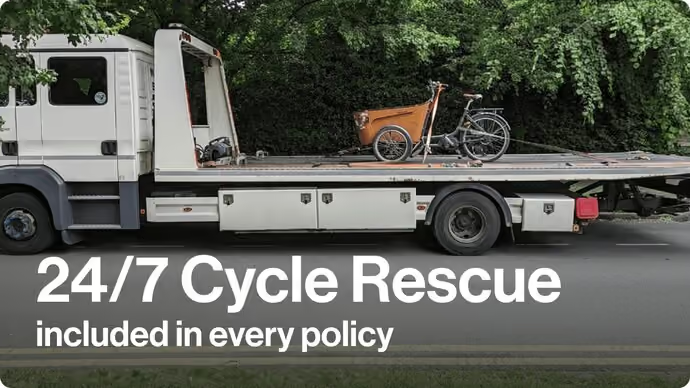
Cycle Rescue is free with ETA bicycle insurance
If you suffer a breakdown (including punctures, or even a flat e-bike battery) while out cycling, our 24-hour Cycle Rescue team is on hand to arrange transport for you and your bicycle to a safe location. The service is included for free with ETA cycle insurance, along with:
• Theft, accidental damage & vandalism
• E-bike battery theft cover
• Cycle Rescue
• No devaluation of your bike over time
• £2m third party PLUS £20,000 personal accident cover
• Shed and garage storage
• Low standard excess of 5% (£50 minimum)
{{cta-ebike}}
We've seen the future, and it's electric
E-bikes aren’t just a trend – they’re proving to be a transport revolution. For city commutes, school runs, cargo hauling and everyday errands, they flatten hills, stretch budgets and bring joy back to everyday travel. And, counterintuitively, making us more active in the process. A 2019 European study found that e-bike riders get more exercise than conventional cyclists, simply because they ride more often and cover longer distances. When people get a help with hills, headwinds, or heavy loads, they tend to pedal more.
At ETA, we’ve seen every myth, worry, and confusion that surrounds e-bikes – from fears over battery fires to uncertainty about what’s legal. This guide busts those myths, explains your rights, and shows how the right insurance can keep you protected.
{{cta-ebike}}
Which e-bikes are legal in the UK?
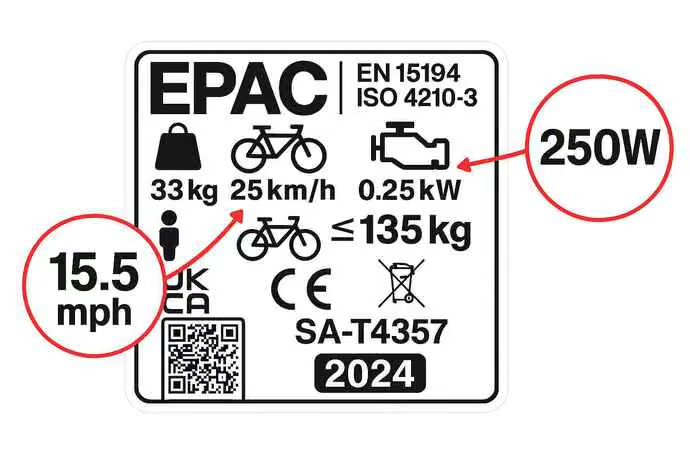
If your bike meets the following rules, it's considered an EAPC (Electrically Assisted Pedal Cycle).
- The motor is no more than 250 watts
- It only assists when you’re pedalling
- Assistance cuts out at 15.5 mph (25 km/h)
That means you’re free to ride on roads and cycle paths just like any other bicycle.
Got a full-throttle model (one that powers you without pedalling)? If it was sold after January 2016, you’ll need to get it registered.
▶️ Find out how to make a full-throttle e-bike legal in the UK
Are e-bikes heavy?
Yes – but not problematically so. A Brompton Electric weighs about 15.6kg; you’ll notice that if you’re lifting it up stairs, but on the move, the motor more than compensates. By contrast, an electric cargo trike like the Babboe Curve tips the scales at 73kg. In both cases, breakdowns -or even a flat battery - can be a drag. That’s why we include Cycle Rescue as standard with ETA insurance – 24/7 breakdown recovery for your e-bike, anywhere in the UK.
▶️ Read more about ETA Cycle Rescue
Do e-bikes go too fast?
Not really. EAPCs are limited to 15.5mph under power – after that, you’re on your own steam. You can adjust the level of assistance to suit your comfort. For new riders, it’s a game-changer: hills and headwinds become manageable.
Are e-bikes expensive to charge or service?
Charging an e-bike costs around 13p per full charge. To work it out: divide your battery capacity (Wh) by 1,000 to get the kWh, then multiply that by your electricity rate.
Servicing is similar to a regular bike. Motors (like Bosch) are sealed units that can last tens of thousands of miles. The added weight might mean more wear on tyres and brake pads, but these are cheap to replace.
.avif)
What about battery fires?
While battery fires make headlines, they are incredibly rare. The main risks come from cheap imports or mismatched chargers.
▶️ Read our full e-bike battery safety guide
The London Fire Brigade advises:
- Buy only from reputable brands and dealers
- Use the charger that came with the bike
- Don’t charge overnight
Do I need insurance for my e-bike?
Not legally. But with many e-bikes costing over £2,000 – and thefts on the rise – insurance makes sense.
Every ETA e-bike policy includes:
- Theft, accidental damage & vandalism
- Battery theft cover (no quibbles)
- 24/7 Cycle Rescue breakdown cover (includes flat batteries)
- No devaluation – your bike keeps its full value for life
- £2m third party + £20,000 personal accident
▶️ Get an instant e-bike insurance quote
Where will I store my e-bike?
If you don’t have the luxury of a garage or easily accessible shed, you don’t need us to tell you how tricky it can be to safely store a bike. And e-bikes can beeven more of a challenge. Whatever you ride, you’re far more likely to cycle if getting to your bike isn’t a massive faff. So it's unfortunate that many cycle insurers have strict rules about how and where you can store your bicycle at home. By contrast, here at the ETA we’ve always been more sympathetic towards these storage challenges.
{{cta-ebike}}
Front gardens
If you store your bicycle or cargo bike in a front garden that’s accessible to the public, we’ll cover it against theft and vandalism on condition you secure it through its frame to an immovable object using the appropriate standard of lock, and you’re able to check on the bike at least once every 18 hours. It’s important to note that when you store your bike in this way, a higher ‘overnight excess’ of 20% (min £100 and capped at £500) applies because it’s been left in an area where access can be achieved without force.
Back gardens
If your garden is secured by a locked gate and isn’t overlooked, we simply ask that it’s secured through its frame to an immovable object using the appropriate standard of lock. If the garden is more easily accessible or overlooked, we’ll still cover it, but you’ll need to be able to check on it at least once every 18 hours (and the higher excess applies).
Sheds and garagesYour shed or garage will need to be locked, but unlike other cycle insurance providers, we don’t specify what type of lock you use. And once your bike is inside, we don’t require you to lock it to anything. However, if it’s visible through a window you will need to cover the bike with a blanket or similar. When you store your bike in this way, the standard excess of 5% applies.
On the street outside your house
If you ride a cargo bike, or are short on space, your only storage option may be the street where you live. ETA cycle insurance will cover you if you secure your bike through its frame to an immovable object in your street as long as you follow our lock requirements, are able to check on the bike at least once every 18 hours, and understand that a higher excess applies.If you have any questions, please get in touch.
Why aren’t e-bikes subsidised like electric cars?
Great question. While EVs get grants, tax perks and charging infrastructure, e-bikes – which are cheaper, greener, and healthier – are overlooked. That’s despite most journeys in the UK being under 5 miles.
▶️ Why e-bikes deserve the same backing as EVs
Subsidies in countries like France, Germany and Belgium prove what’s possible: lower-cost access, cleaner air, and more people cycling. If the UK is serious about net zero, it’s time we caught up.
How do I look after an e-bike battery?
If you’ve splashed out on an e-bike, the battery is the single most expensive (and important) part of it. Treat it well, and it’ll keep you rolling for years. Neglect it, and you could be facing an expensive bill sooner than you’d like as a replacement can cost mare than £500. The good news? Looking after your e-bike battery is easy - you just need to follow a few simple steps.
Lithium-ion batteries don’t like extreme heat or cold. Think of your battery as a temperamental houseplant: it’s happiest in a nice, stable environment. Leaving it in a hot car or in direct sunlight will shorten its lifespan, while charging it when it’s freezing cold can damage the cells. The sweet spot? Store it somewhere cool (below 20°C) and let it warm up a bit before charging if it’s been out in the cold.
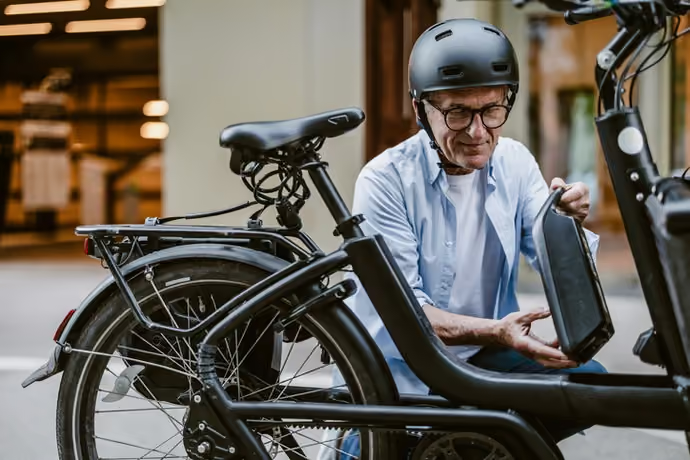
Cold weather affects performance, so don’t be surprised if your e-bike’s range drops on chilly days - it’s totally normal. To help combat this, store the battery indoors when you’re not riding. And remember to avoid charging it when it’s freezing cold- let it warm up to room temperature first.
If you’re not using your e-bike for a while, don’t just shove the battery in a cupboard and forget about it. Lithium-ion batteries slowly lose charge over time, and if they drop too low, they can suffer damage. Ideally, store it with a charge of about 80%, and give it a top-up every couple of months if needed. Some chargers have a special ‘storage mode’ to help with this.
▶️ Learn more about our specialist e-bike insurance
It’s tempting to leave your battery on charge overnight or whenever you’re not using it, but lithium-ion batteries prefer a little breathing room. Keeping it at or very near 100% for long periods of time may even shorten its lifespan. If you can, unplug it once it’s fully charged and try to keep it in the middle of its charge cycle as much as possible.
Unlike old-school batteries, lithium-ion ones don’t like to be fully drained. Running your battery down to empty on a regular basis will wear it out faster. Partial discharges are actually better for longevity, so if you’re only doing short rides, it’s fine to charge every few trips rather than after every single ride.
{{cta-ebike}}
This might sound obvious, but always use the charger that came with your e-bike - or one recommended by the manufacturer. Mixing and matching chargers can lead to compatibility issues, reduce efficiency, or, in the worst-case scenario, create a battery fire risk.
Can I insure an electric cargo bike?
Yes. You can protect your precious cargo with specialist cover from the ETA. We have been in the game longer than anyone – over 30 years – and we hope it shows. Our policy covers theft, damage and vandalism, but also goes beyond the basics. There’s no devaluation, ever. Batteries are covered with no fuss. And if you break down, even with a full load of groceries and a sleepy toddler on board, our 24/7 Cycle Rescue service will come and fetch the lot of you.
The ethical choice
The ETA was established in 1990 as an ethical provider of green, reliable travel services. Over 30 years on, we continue to offer cycle insurance , breakdown cover and mobility scooter insurance while putting concern for the environment at the heart of all we do.
The Good Shopping Guide judges us to be the UK's most ethical provider.
Information correct at time of publication.
Leave us a comment
