




Driverless cars are coming – but how safe is “safe enough”?
July 29, 2025
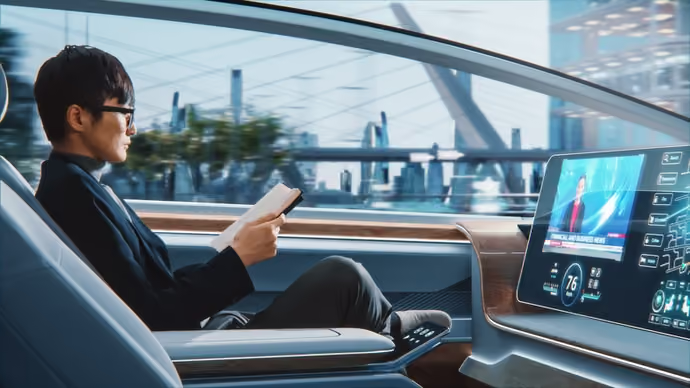
Hands up if you thought driverless cars were going to make roads safer. After all, when 88% of crashes are said to be down to human error, swapping distracted, tired, or overconfident drivers for cool-headed algorithms seems like a no-brainer.
But now, with autonomous vehicles set to hit UK roads next year, the picture feels a little less utopian - and a lot more…human.
A press release accompanying the launch of the new Automated Vehicles Act offers the usual optimistic tone. Future of Roads Minister Lilian Greenwood calls it “one of the most exciting opportunities to improve transport for so many people, especially those in rural areas or unable to drive.” And she’s not wrong - done right, AVs could be transformative. Safer roads, new jobs, investment in transport innovation, and better access for those currently locked out of our car-dominated system.
But there’s something conspicuously missing: a clear, ambitious safety target.
A surprisingly human benchmark
The Act sets a benchmark: self-driving systems must be as safe as a “competent and careful” human driver.
At first glance, that seems fair. But take a closer look and the cracks start to show. For a technology that’s sold on precision - sensors that don’t blink, software that doesn’t text and drive - “good human” feels like an oddly low bar.
When autonomous vehicles first rolled out in tech demo videos, the promise was grand: no more drink driving, no more speeding, no more deadly lapses in judgement. Fast-forward a decade and the bar is set at... better than the average British motorist. Apparently, if we currently tolerate around 1,600 road deaths a year, anything marginally better is progress.
Except it isn’t.
If the UK were truly serious about reducing road deaths - and if autonomous tech is to be the tool that delivers it - then the standard shouldn’t be "a bit safer than Dave in a Ford Focus.” It should be aligned with Vision Zero - a commitment to eliminating death and serious injury through safer systems, not just safer users.
However the term is often applied without intent. “As safe as a competent human” sets today’s risk level as the baseline, not the ceiling. It shrinks what should be an ambitious public health mission into something blandly incremental. Worse, it risks perpetuating the idea that some casualties are just the cost of doing business.
Would we accept that approach in aviation? Or in rail travel? Hardly.

What about public trust?
Lilian Greenwood is right to highlight the potential: autonomous vehicles could unlock mobility for people in rural areas, for older adults, for those who can’t or don’t drive. They could, in theory, obey every speed limit and never pull out for a risky overtake. They might even stop for pedestrians without being prompted.
But all of that depends on public confidence - and confidence doesn’t come from press releases. It comes from setting standards and meeting them. When robo-taxis in the US have made headlines, it’s rarely for the right reasons: big fanfare, followed by a serious crash, a short pause, a software update - and back on the road. The UK can’t afford to follow that playbook. If we’re going to embrace this tech, we need autonomous vehicles that are entirely law-abiding. Not just mostly. Not just when it’s convenient.
Should we accept algorithmic crashes as progress, simply because they’re fractionally less frequent?
We already have a car-dependent system that tolerates far too much harm. Autonomous vehicles could change that. But only if we demand better - from the tech, the regulators, and ourselves.
Across the pond: a cautionary tale
Need a reminder of why clear, ambitious safety targets matter? Look to California. Last week the state’s Department of Motor Vehicles asked an administrative judge to suspend Tesla’s licence to sell cars for allegedly misleading customers into believing its vehicles could drive themselves without human oversight.
Regulators argue that branding like “Autopilot” and “Full Self‑Driving” implies autonomy the cars don’t deliver, breaching consumer‑protection laws. Tesla insists it has always told drivers to keep their hands on the wheel, but the hearing underscores how quickly public trust evaporates when promises outpace reality.
If California - cradle of AV innovation and Tesla’s biggest market - can threaten a sales ban, the UK can’t afford woolly targets that let companies trade on the aura of autonomy.
Cycle Rescue is free with ETA bicycle insurance
If you suffer a breakdown (including punctures, or even a flat e-bike battery) while out cycling, our 24-hour Cycle Rescue team is on hand to arrange transport for you and your bicycle to a safe location. The service is included for free with ETA cycle insurance, along with:
• Theft, accidental damage & vandalism
• E-bike battery theft cover
• Cycle Rescue
• No devaluation of your bike over time
• £2m third party PLUS £20,000 personal accident cover
• Shed and garage storage
• Low standard excess of 5% (£50 minimum)

{{cta-cycling}}
The ethical choice
The ETA was established in 1990 as an ethical provider of green, reliable travel services. Over 30 years on, we continue to offer cycle insurance , breakdown cover and mobility scooter insurance while putting concern for the environment at the heart of all we do.
The Good Shopping Guide judges us to be the UK's most ethical provider.
Information correct at time of publication.
Leave us a comment
