




A beginner’s guide to e-bike motors and batteries
April 27, 2026
Don’t let anyone tell you UK e-bike rules can’t be complicated. While it’s true that buying an e-bike from a reputable dealer on the high street pretty much guarantees it will be above board, online retailers are a mixed bag. In many cases, they are based abroad where rules and regulations are different. This is especially true of e-bike kits, which can be too powerful to be used legally on UK roads.
Wherever you buy your e-bike from, it’s your responsibility to ensure it complies with UK law.
How can I tell if my e-bike is legal?
One of the best things about e-bikes is you can use them as freely as a normal bicycle: that means full access to cycle lanes, and no legal requirement for registration, a driving licence, vehicle excise duty, insurance or a helmet. However, to enjoy these benefits, the e-bike must comply with EAPC (electrically assisted pedal cycle) rules.

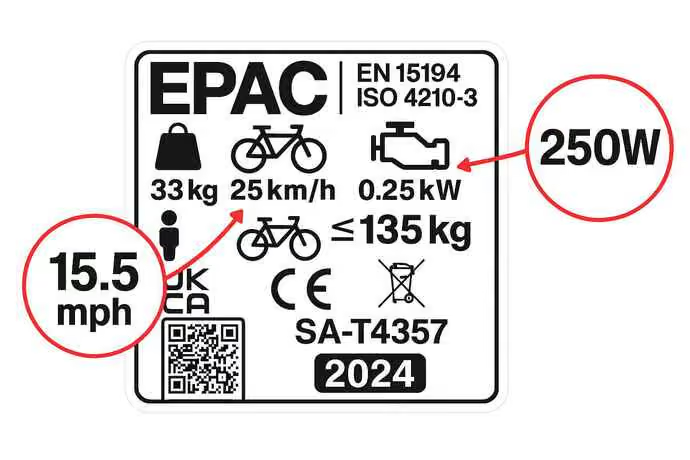
Your e-bike should have a plate or sticker somehwere on its frame that states the manufacturer’s name and the motor size, and maximum speed at which the motor can propel the vehicle.
In practice, some don’t. To be EAPC compliant, the electric motor must be no bigger than 250W, and cut out at 15.5mph (25 km/h). And the e-bike must have pedals. There are rules about throttles, too.
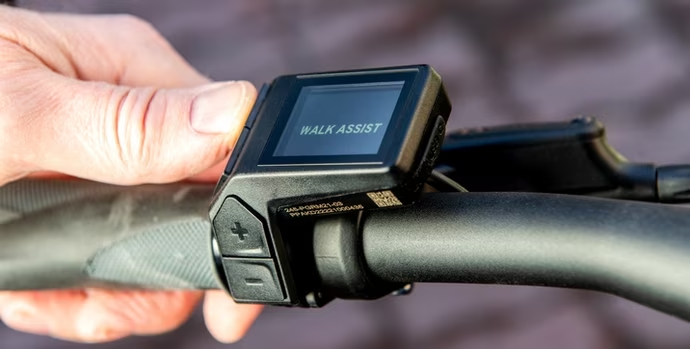
UK law allows for a throttle that cuts out at about 4mph. It’s a “walk mode” feature to help wheel the bike. If you want a throttle that works all the way up to the 25km/h legal limit without any need for you to pedal, the bike will need to be tested and categorised as an L1e 250W e-bike. Some manufacturers such as Wisper Bikes can carry this out on your behalf.

{{cta-ebike}}
What's the difference between e-bike motor size and battery capacity?
If an e‑bike was a car, its battery would be the fuel tank. The electric motor’s power is measured in watts (W) which is like the size of the engine, fixed at 250W for road‑legal e‑bikes. The battery is described by two figures: its voltage (V), which is how the system is set up, and its capacity in watt‑hours (Wh), which tell you how much “fuel” it can hold.
Unlike the motor, which is capped at 250W, there’s no legal limit on battery voltage or capacity, which is why you’ll see bikes with very different battery sizes. So two e‑bikes can have the same 250W motor, just like two cars with the same engine, but if one has a bigger battery, it’s like having a larger fuel tank: it won’t be more powerful, it will just go further and cope better when you’re asking a lot of it, like on long or steep climbs.
For example, an entry-level commuter e-bike might have a battery with a capacity of 400Wh and the Tern GSD cargo bike is available with a 800Wh battery. Both have a 250W motor.
How fast can you go on an e-bike?
UK e-bike regulations limit motor assistance to just over 15mph (25km/h). At that speed the motor must cut out and stop helping. You can go faster, but you will need to pedal and maintain the higher speed under your own steam.
What is an e-moto?
Media reports often mislabel off-road electric motorbikes like the Sur-Ron as “e-bikes”, even though they have throttles, no pedals, and motorcycle performance. Failure to distinguish between the two categories creates confusion and makes enforcement harder. It’s why there are calls for the term “e-moto” to be adopted as a catch-all term for electric motorcycles.

What is the penalty for riding an overpowered e-bike?
Any e-bike with a motor bigger than 250W, or an assisted speed over 25km/h is a moped or motorbike. Failure to register an overpowered e-bike can result in seizure, a £300 fine and six penalty points on your driving licence. For under-18s, penalty points accumulated before they obtain a full driving licence carry over, potentially leading to an automatic ban under the New Drivers Act.
What happens if the police seize your e-bike?
If the police seize your e-bike, they are likely to use either a Section 59 (anti-social use, inconsiderate riding on the road, off-road riding without permission, causing or likely to cause alarm, distress or annoyance), or a Section 165A if officers believe the vehicle’s being used without insurance or the correct licence. E-bikes that do not conform to EAPC rules are treated in law as mopeds or motorbikes.
What's the difference between EAPC and EPAC?
There's no difference and the terms are used interchangeably.
Can I register an e-bike with a powerful motor?
It’s easier to buy an electric moped or e-moto off the shelf, but if you have an e-bike that’s too fast or powerful to be categorised as an EAPC that you want to register, the following vehicle categories apply specifically to lower-powered models.
L1e-A are low-powered mopeds with motors up to 1,000W and a top assisted speed of 25kph (15.5mph). You’ll need a provisional or AM-category licence to ride one unless you passed your full UK driving test before February 2001.
L1e-B are another category of low-powered moped (sometimes called speed pedelecs) with an electric motor up to 4,000W and a maximum assisted speed of 45km/h (28mph). You’ll need a provisional or AM-category licence or the grandfather rights mentioned above.
Any electric bike exceeding these speed and power thresholds is legally a motorcycle, requiring the appropriate A1, A2, or A licence.
Can you get insurance for a 750W e-bike?
Any e-bike with a motor bigger than 250W cannot be covered by cycle insurance. For example, an e-bike with a 750W motor would need to be registered and insured as either a moped or motorcycle. Remember that motor insurance is a legal requirement. Failure to insure an electric moped or motorbike of this type can result in a fine of £300 and 6 penalty points, and if the case goes to court you could get an unlimited fine and a driving ban. The police also have the power to seize and destroy a vehicle that is being driven uninsured.
E-bikes that conform to EAPC rules can be covered by a cycle insurance or home insurance policy.
{{cta-ebike}}

What’s the difference between type approval and SVA for e-bikes?
Before manufacturers can sell a vehicle for use on UK roads, they need to demonstrate it meets the required standards via a process known as type approval. Once granted it applies to all examples of that design. SVA (single vehicle approval) is a similar process individuals can use to register a vehicle on a one-off basis. In the case of e-bikes, you might use MSVA (the M stands for motorcycle) it to register an EAPC that has a full throttle function as a 250W LPM (low-powered moped).
Anyone can take their e-bike to an approved MVSA centre and apply for SVA. The cost of the test and certification is £55.00, which is payable to the DVSA and paid at the time of booking the test appointment.
My e-bike is twist and go – is it legal?
It might be. E-bikes manufactured before 2016 are permitted to have a full throttle function, which means you don’t have to pedal at all if you prefer not to. This is sometimes called “twist and go”. E-bikes made since 2016 are allowed a “walk mode” throttle that helps when the bike is being wheeled, but if you want the full throttle feature you will need to buy one that is designated as an L1e 250W e-bike. You can buy one off the shelf or have SVA (Single Vehicle Approval) certification carried out on your own bike at an MVSA test centre. Read our guide to e-bike throttles.
How can I make my e-bike go faster?
Bigger e-bike motors produce more power, which makes them faster but beware. Any e-bike with a motor bigger than 250W is no longer categorised as a bicycle. That means you will need the appropriate driving licence, registration and insurance. The same goes for bikes with 250W motors that have been modified to go faster than 15.5mph (25km/h).
What are the e-bikes that can do 30mph?
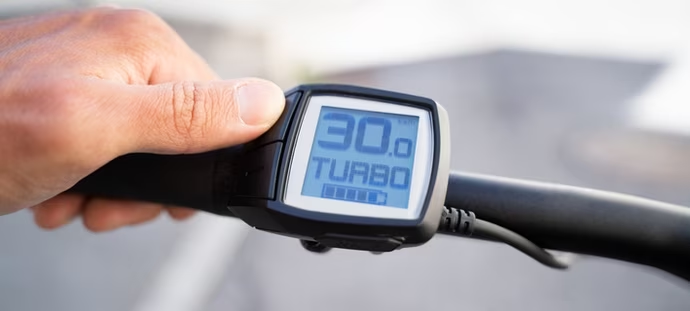
Speed pedelecs are a type of e-bike equipped with motors of 500W - 900W and capable of 45km/h (28mph). They look like a regular e-bike but they are categorised as a moped (L1e-B) not an EAPC. That means the speed pedelec needs to be registered, insured and you need an AM licence to ride it. The exception is drivers who passed their full UK driving test before February 2001, as they have so-called "grandfather rights" to ride a moped without L-plates or Compulsory Basic Training (CBT).
Is off-road or "boost mode" legal?
Some e-bikes come with various power settings, but even if you are using a speed limiter, if the motor is bigger than 250W it is a moped or motorcycle cannot be used on the road unless it is registered. According to the Department for Transport:
"Some electric cycles offer a temporary increase in top speed that is often advertised as ‘off road’ mode. When ‘off road’ mode is activated, the vehicle can be propelled by the motor at a speed greater than 15.5 mph. Vehicles that have this feature do not, in our opinion, comply with the EAPC regulations and are considered motor vehicles."
How long does an e-bike battery last?
If you take care of an e-bike battery, it should last at least 1,000 full charge cycles before you start noticing a drop in range. We know of e-bikes over a decade old that still use their original battery and work fine. That said, you run the risk of damaging a battery if you leave it uncharged for months, especially in a cold shed. Before storing your bike for any extended period, charge the battery to about 50% and check it every few weeks.

How much does it cost to service an e-bike motor?
E-bikes servicing tends to be 10-15% more expensive than having an analogue bicycle checked over because it involves motor and battery diagnostics, as well as occasional updates to software. The physical motors themselves don't need much work. For example, Bosch e-bike motors are sealed for life and can do over 50,000 miles (80,000km) without problem. You might find the heavier weight of the bike means you go through a few more brake pads and tyres, but these are relatively inexpensive items.
How much does it cost to charge an e-bike battery?
A full charge for an e-bike battery can cost as little as 13p although the exact figure depends on your electricity rate and the size of the battery.
Take your e-bike's battery capacity (Wh) and divide by 1,000 to get the kWh (kilowatt hours). If you multiply this figure by the kWh rate your electricity supplier charges you'll get the price of a full charge from empty. For example, if the rate you pay is £0.28 per kWh and your battery is rated at 500Wh, it will cost 14p for a full charge.
Does adding a motor and battery to a bicycle mean less exercise?
It sounds counterintuitive, but using an e-bike does not automatically mean you get less exercise than riding a conventional bicycle. Research has shown that people tend to ride e-bikes further and more frequently than they would a regular bike. On top of that, e-bikes allow you to reduce assistance from the motor if you want to work a little harder.
Are the motors and batteries on e-bike kits safe?
Wisper Bikes CEO and founding member of The British Electric Bicycle Association, David Miall, told us: "Unfortunately, e-bike retrofit kits aren’t regulated, so they’re legal to sell, and legal to buy, but once they’re fitted to a bike it can go into a grey area. We don’t sell kits because of the inherent dangers involved. Kits are fine if they are going on a bike that is strong enough to take a kit, but the problem is that a lot of people will buy a kit that is a powerful piece of machinery and put it on a bike that is, quite frankly, not strong enough to take the extra weight or the extra speed."

As well as checking your bike is up to the job of having an electric motor fitted, make sure that the kit conforms to EAPC rules and never mix and match chargers. Only ever use a charger approved by the motor manufacturer.
Is an e-bike crank motor better than a wheel hub motor?
There’s a good reason most e-bike manufacturers fit a mid-drive (crank) motor. The arrangement is more efficient because it keeps weight centralised and works with your bike’s gears. By contrast, a hub-mounted motor simply propels the wheel. You can get mid-drive kits, but they are more fiddly to install than a hub motor which often comes pre-installed into a wheel that you can fit to your bike in minutes.

What happens if my e-bike battery runs out mid ride?
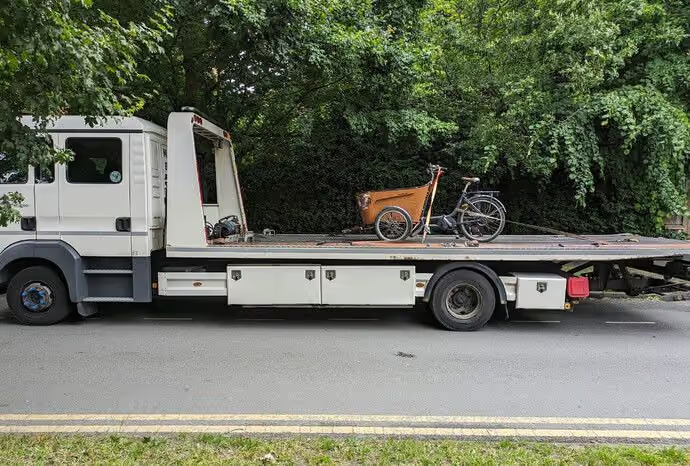
If the battery dies, the bike reverts to being a normal (if slightly heavier) bicycle. That’s where ETA’s Cycle Rescue 24/7 breakdown recovery service comes in. If you’re stranded with a flat battery (or a puncture, broken chain, or any other mechanical failure), you and your bike will be picked up and taken somewhere safe.
The ethical choice
The ETA was established in 1990 as an ethical provider of green, reliable travel services. Over 35 years on, we continue to offer cycle insurance , breakdown cover and mobility scooter insurance while putting concern for the environment at the heart of all we do.
The Good Shopping Guide judges us to be the UK's most ethical provider.
{{cta-ebike}}
Information correct at time of publication.
Leave us a comment
