




Short car trips: hard on engines, the environment and your wallet
August 6, 2025
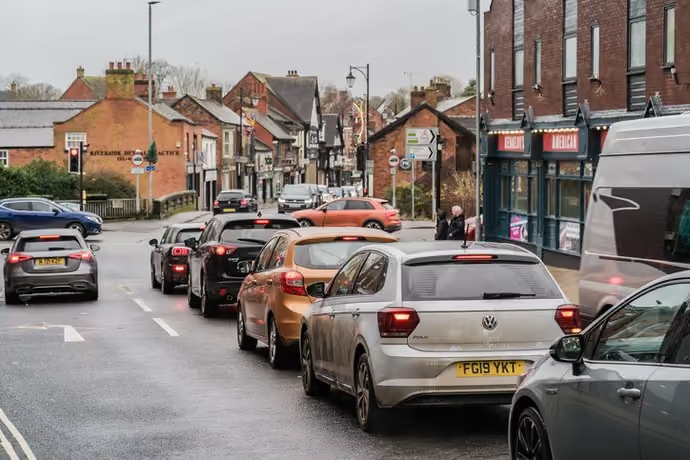
We already know why ditching short car hops makes sense: cleaner air, safer streets, healthier bodies. But there’s another reason to leave the keys on the hook for the school run or corner-shop dash: according to our estimates, UK motorists burn an extra £0.9 billion a year in fuel because engines and exhausts spend those minutes running cold. That’s before you count the batteries and diesel particulate filters that hate stop-start, never-quite-warm use.
The first few minutes after a cold start are where the lion’s share of engine wear occurs. Cold metal expands slowly. Oil flows thick when cold. And no amount of clever software or exotic oil formulations can change that. So if your car lives a life of short journeys, don’t be surprised if it wears out faster than it should.

For example, diesel particulate filters need sustained heat to work efficiently. Repeated short trips mean the filter never regenerates properly, which can lead to expensive bills. Petrol engines suffer too as short trips can mean faster deposit build-up in fuel injectors.
Batteries don't escape the abuse either. Short journeys don’t give the alternator time to replenish what the starter motor used.
The problem is, we do it so often. Around two-thirds of urban car trips are under three miles. And across the UK, almost a quarter of car journeys are under two. These are precisely the trips where engines don’t get hot and as a result the first few miles account for a disproportionate share of your car’s total emissions.
{{cta-breakdown}}
It’s tempting to think the cost is personal - a bit more fuel here, a shorter battery life there. But scaled up across the UK, those inefficiencies become something much bigger. The estimated £0.9 billion burned in avoidable fuel each year isn’t some abstract figure – it represents a huge waste of resources not to mention a spike in local air pollution.
So what’s the answer? The obvious one is also the simplest: don’t use a combustion engine for trips better suited to cycling or walking.
Policy should play its part, too. If most car trips are under three miles, then those are the journeys we need to design streets around.
.avif)
The ethical choice
The ETA was established in 1990 as an ethical provider of green, reliable travel services. Over 35 years on, we continue to offer cycle insurance , breakdown cover and mobility scooter insurance while putting concern for the environment at the heart of all we do.
The Good Shopping Guide judges us to be the UK's most ethical provider.
Information correct at time of publication.
Leave us a comment
