



The missing half of British cycling
March 25, 2026

Where cycling is treated as a normal way to get around, women ride as much as men. In Britain, that still feels a long way off.
On a weekday morning in Britain, you can stand by a cycle lane and count the riders. Outside Cambridge and Oxford, the tally is likely to look oddly lopsided, because far fewer women than men cycle in the UK.
The Department for Transport’s National Travel Survey lays out the gap plainly: men make 33 cycling trips a year on average, women 12.
There’s no mystery about why things are this bad. Or why places like Cambridge buck the trend. The gender gap tends to be widest in places where road conditions feel hostile, and narrowest where there's good infrastructure.
Women cyclists are, in effect, an indicator species. Gender parity is one of the quickest ways to tell whether a place has succeeded in making cycling an ordinary, everyday activity. It’s why in the Netherlands, women cycle more often than men.
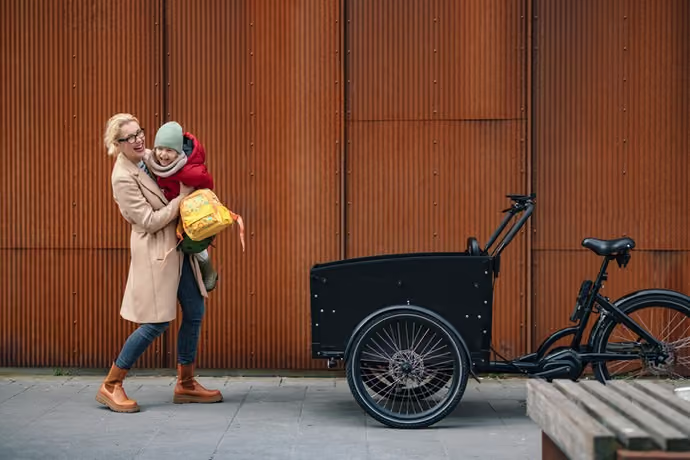
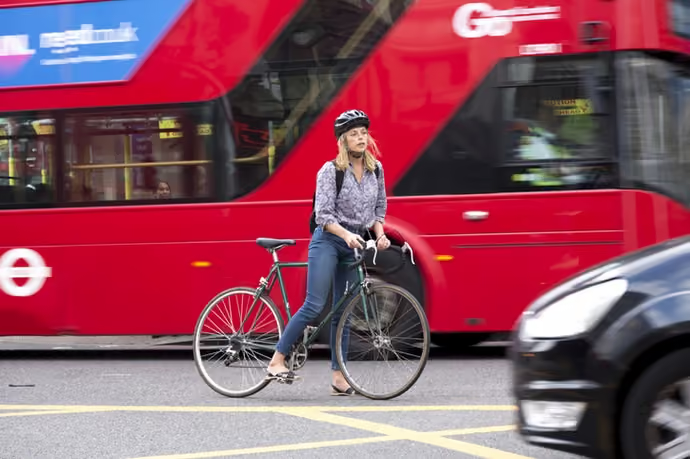
In Britain, attitudes towards cycling can feel as hostile as the roads. Cyclists are still too often reduced to a set of unhelpful caricatures: the hardy commuter in hi-vis, the Lycra-clad weekend warrior, the kid pulling wheelies through an estate. Ride in ordinary clothes, to do ordinary things, and you are all but invisible to the media, government and town planners.
Rachel Aldred, a sociologist who has spent years listening to how people talk about cycling in the UK, describes a trap in which cyclists are cast as either as a “proper cyclist”, or not competent enough. In other words, you can get it wrong whatever you do.
When cycling is characterised as fast, risky, technical, or “for a certain type”, people who do not identify with that group are more likely to stay away.
This helps explain why sport is not the answer to the gender gap. Reviews of Olympic legacy claims find little proof that sporting success gets large numbers of people active, while the cycling-specific evidence after London 2012 points more to a burst of enthusiasm than to a lasting transformation in everyday riding.
Nor does the promotion of sports cycling make it feel normal to ride in a dress, or with a child, or at a pace that's not trying to win at anything.
"Cycling countries" aim for riding a bike to be as unremarkable as walking, rather than just another hobby.
{{cta-cycling}}

In the Netherlands, the bicycle is closer to a household appliance than a lifestyle choice: a simple tool that makes life easier. Cycling is simply one of the ways people move. In Britain, by contrast, the bike is still too often treated as a statement about the kind of person you are. And all the while, we keep trying to manufacture normality through promotion rather than design.
Safety in numbers
Cycling advocates often talk about the “safety in numbers” effect: the more people cycle, the more normal it looks, and the safer it becomes.
It’s a virtuous circle that quickly redresses gender imbalance: a Cambridge-led study of 17 countries found a tipping point at around 7% of all trips being made by bike. Above that, places see at least as many women cycling as men.
A major stumbling block to the safety in numbers chain reaction is that cycling in the UK is widely perceived as unsafe. That perception is enough to keep cycling niche, with the riders willing to tolerate the conditions disproportionately male. Research in England in 2020 found that two thirds of adults felt it was too dangerous for them to cycle on the roads, a view especially common among women and older people.
This is why good-quality segregated infrastructure matters so much.

Gender balance is more than a metric of fairness. Low levels of women cycling matter beyond the current generation because research has found that mothers have more influence than fathers over whether their children cycle to school.
It also matters because ideas about who cycling is for take hold early. If girls see cycling as something boys do, they are more likely to drop it as they get older. A Sustrans report found almost twice as many boys as girls cycling frequently, a disparity that echoes into adult life.

What a more equal cycling Britain would look like
If Britain wanted a cycling culture with anything like a balanced gender split, it would have to start making the roads feel less hostile.
That means widespread protected routes of the kind we built in the 1930s: segregated cycle tracks which were routinely built alongside new UK roads. What now seems radical to some is, in fact, a return to something Britain once recognised the value of.
But infrastructure is only part of it. Bad driving has to be tackled too. Research by Cycling UK found that more than half of women, 58%, said their cycle journeys were limited by safety concerns and a lack of suitable infrastructure, while 36% pointed to roads not feeling safe enough and 23% to a lack of dedicated cycle routes as significant barriers to cycling.
It also means dropping the idea that cycling has to be sold as a special identity. It needs to be boring. Or rather, it needs to be boring in the way walking is boring, a thing you do without having to perform it.
FAQ: could a UK government really close the cycling gender gap?
Do most people in the UK support building more cycle lanes and safer routes? Yes, and in far greater numbers than you might think given how cycling is portrayed in the media. A Cycling UK survey in 2024 found 64% supported encouraging more people to cycle, and 70% wanted more cycle friendly routes. In a report on women and cycling, 79% of women supported building more protected cycle lanes, even if that meant less space for other traffic.
If the public is broadly supportive, why do bike lanes and LTNs still cause such a political row? Because the opposition is often concentrated, organised and immediate, while the benefits are dispersed and slower to feel. LTNs in particular can become lightning rods if people get the impression schemes are imposed, poorly explained, or shift traffic to boundary roads. It is also easy for active travel to be framed as a culture war proxy, which makes ministers twitchy.
Is a Dutch style transformation within one parliament realistic? No. A full overhaul at national scale in a single parliamentary term is unlikely. The UK struggles with long-term delivery that spans departments and electoral cycles, and active travel schemes are unusually exposed to local backlash.
What is realistic if ministers actually want to narrow the gender gap? A decade-long programme with consistent funding. Safer school journeys are one of the quickest wins because the benefits are large and obvious; safer streets, greater independence for children, cheaper travel, healthier communities and climate, cleaner air, improved public health, and less reliance on expensive natural resources.
What will it cost? We will not fix a gender imbalance shaped by decades of car-first planning with funding that arrives in short bursts that barely cover the basics. The government committed almost £300m for 2024 - 2026 for walking, wheeling and cycling schemes, and £616m for 2026 - 2030 for Active Travel England. That works out at roughly £150m a year. That’s only about £2.60 per person per year. And remember, covers walking too. By comparison, the Netherlands has historically spent about £24 per person per year on cycling. The Institute for Public Policy Research has argued for £35 per person per year for a decade on active travel infrastructure including 25,000 miles of protected cycle paths, plus £15 per person per year on soft measures such as training and access schemes.
The ethical choice
The ETA was established in 1990 as an ethical provider of green, reliable travel services. Over 35 years on, we continue to offer cycle insurance , breakdown cover and mobility scooter insurance while putting concern for the environment at the heart of all we do.
The Good Shopping Guide judges us to be the UK's most ethical provider.
{{cta-ebike}}
Information correct at time of publication.
Leave us a comment
