



Driving in France: 2025 rules, toll hacks & low-emission zones explained
July 25, 2025
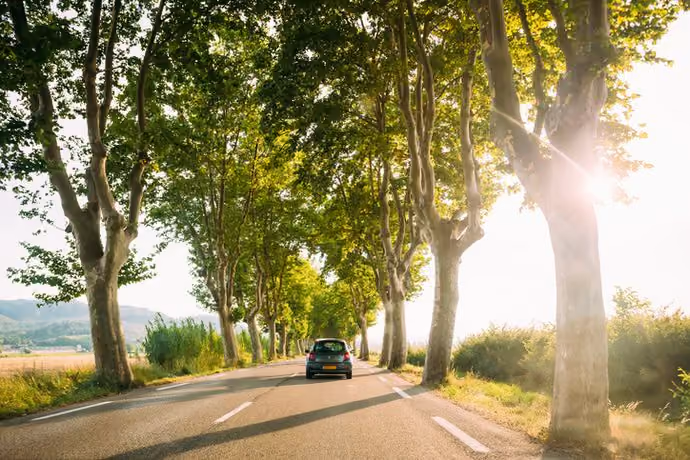
Rolling off the ferry or out of Le Shuttle, everything looks reassuringly familiar - until the first roundabout looms and you’re on the wrong side of the car, scanning for signs in kilometre‑speak.
You don't need us to tell you French roads are a joy: velvet‑smooth tarmac, picnic‑worthy service areas and scenery that flicks from chalk cliffs to sunflower fields in a heartbeat. But a handful of quirks can turn that holiday glow into an on‑the‑spot fine faster than you can say bonjour monsieur l’agent. Here’s what you need to know for summer 2025.
Paperwork and kit
Bring your photocard driving licence, V5C logbook and proof of insurance. Green cards are history for UK drivers, but a printed certificate is still handy. If you were baffled by the demise of the GB sticker, you are not alone. After all, French drivers are familiar with "GB" as the identifier for British vehicles, since "Grande-Bretagne" is the French term for Great Britain. Still, we are where we are and your number plate now needs either the new “UK” identifier or a UK sticker.
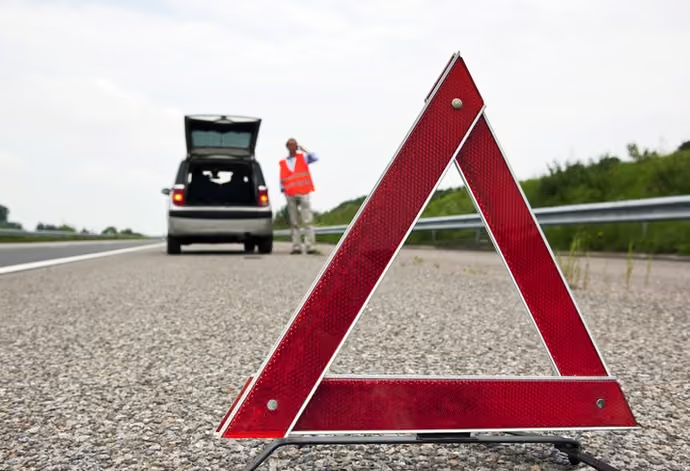
Inside the cabin stash a warning triangle and hi‑vis vests - one per passenger - because French law says you must be able to pop them on before you step onto the hard shoulder.
Some modern vehicles do not require stick-on deflectors if they have adaptive headlights or switchable beam patterns (often found in newer LED, Xenon, or Matrix systems) sometimes referred to as “continental driving mode” or “tourist mode” by manufacturers. For other cars, headlamp deflectors are a must along with spare bulbs and fuses. These items don't cost much - unless, of course, you wait until you're in the ferry or Eurotunnel terminal to buy them.
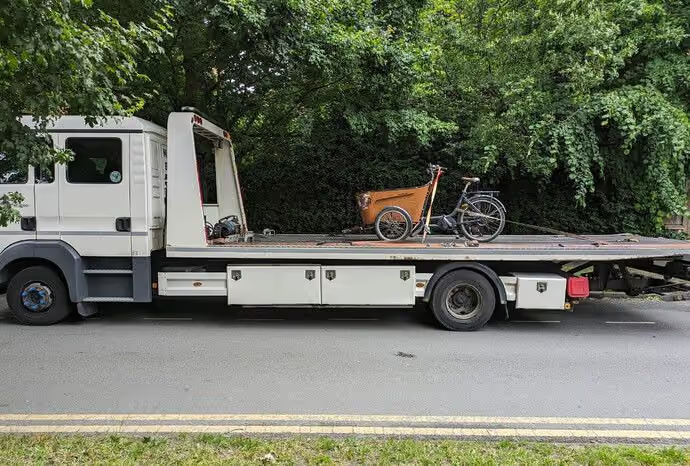
Another thing that's worth investing in before you set off is European breakdown cover. For short-term trips, single-trip European breakdown cover, ETA offers some of the best value on the market. With 24/7 assistance and English-speaking helplines, you’ll have peace of mind knowing help is just a phone call away.
Crit’Air: the pollution sticker that decides where you’re welcome
From 1 January 2025, every French urban area with more than 150,000 residents must run a low‑emission zone. That’s 40‑plus cities, each policed by a tiny windscreen vignette called Crit’Air. The sticker ranks vehicles from 0 (electric) to 5 (pre‑2006 diesels). Many councils will bar Crit’Air 3 and older vehicles during the week, so that faithful 2008 diesel estate might suddenly be persona non grata in Lyon, Lille or Toulouse.
Order direct from the French government for €4.61 - allow a fortnight for post. Cars built before 1997 and motorbikes from before 2000 can’t get a sticker at all.
Easy-to-miss rules for British drivers
Drive on the right, obviously, but remember priorité à droite in towns: unless a yellow‑diamond sign says otherwise, cars joining from the right have right of way. Speed limits are 130 km/h on dry motorways, 110 km/h on duals, 80 km/h on ordinary rural roads and 50 km/h in towns; rain knocks those first two down by 20 km/h.
Alcohol? France allows 0.5 g/L of blood alcohol (as opposed to 0.8 here in Britain) - but novice drivers on a French probationary licence have to stay below 0.2 g/L. Some websites will insist this law appllies to drivers irrespective of their nationality, while others say it affects only those who hold a "permis probatoire" - a probationary licence that applies to all new drivers in France and is valid for three years. The best advice is to avoid alcohol completely if driving - irrespective of where and when you got your driving licence.
Surviving the péage
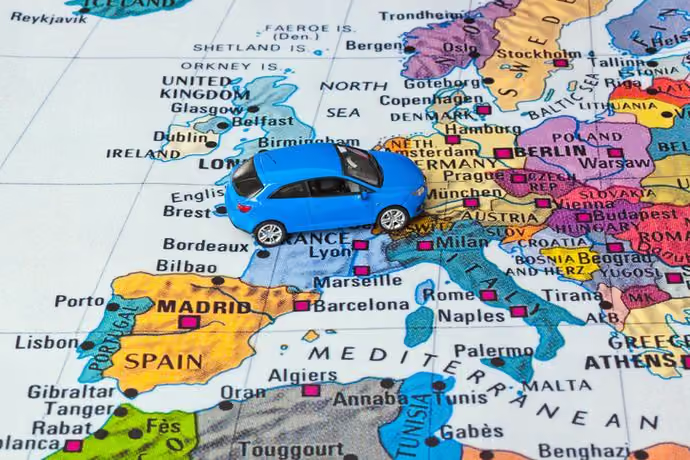
Most French motorways charge a toll that buys you smooth asphalt for miles and picnic tables under the pines. Friday rush hours in July and the dreaded “black Saturday” at the start of August can turn toll lanes into car parks, so get yourself the Liber-t tag. It’s a small electronic box that sticks to your windscreen and opens the barriers automatically charging you on your return to the UK. The experience of avoiding the queues and breezing through motorway "t" lanes at at 20km/h never getsd old.
The tag works across the entire French autoroute network and in hundreds of car parks, making it an obvious choice if you drive in France even once every year. Providers like Bip&Go and Sanef offer flexible subscriptions depending on how often you travel, and the setup is surprisingly hassle-free. It won’t magically shorten the A7 in August, but it will take the edge off the journey.
The Bip&Go pay-as-you-go plan is about as low-commitment as it gets for driving in France. You pay €1.90 - but only in the months you actually use the tag. There’s a one-off €10 activation fee when you first subscribe, but if your Liber-t tag spends the rest of the year in a drawer, that’s fine - no charges until you hit the road again. Fancy venturing into Spain, Portugal or Italy? Add €2.50/month per country when you travel, and you’re sorted. Oh, and yes - UK delivery is available. No need to faff about in France to get set up.
Don't forget...
Any device that flags exact camera locations (even some sat‑nav functions) is illegal. Hands‑free calls only, headphones banned. And if you ride a motorbike or scooter, pack CE‑approved gloves; the law applies to passengers, too.
Service area stops (at least) every two hours are a good antidote to fatigue, complete with playgrounds and smooth coffee.
Many smaller French towns feature “zone bleue” parking - free, but strictly time‑limited. To use it legally, you must display a European-standard blue parking disc (disque de stationnement) clearly on your dashboard, set to your arrival time. These can be picked up at any tabac, mairie, or tourist office for around €1–3 - some places even hand them out for free. Depending on the town, time limits typically range from 30 minutes to 90 minutes, with grace periods for lunchtime or evenings (check local signage). Forget the disc, use an expired or non-compliant one (the old black dial is no longer accepted), or overstay the allowed period, and authorities can issue a €35 fine under article R.417‑3 of the Highway Code
Watch out for wildlife: dusk on a Dordogne back‑road is prime time for deer, buzzards and the occasional sanglier (wild boar) sprinting - or swooping - across your beam.
Bonne route!
Information correct at time of publication.
Leave us a comment
