





Buying a mobility scooter and living with it day to day
December 16, 2025
Mobility scooters are a common sight across Britain. Yet for all their visibility, mobility scooters have to navigate not only fragmented pavements, but uneven information and rules that many users may never hear about.
Official guidance exists, but it is scattered and incomplete. The Highway Code mentions mobility scooters only briefly and offers little practical advice, while DVLA information focuses on paperwork rather than day-to-day use. Local authorities publish their own interpretations, which can contradict each other.
This guide sets out how to make sense of the rules and regulations, how to choose a scooter, and how to live with it day to day.
Buying a secondhand scooter
First things first. There are two types of mobility scooter, and while they can look similar to each other, there are important differences. Class 2 scooters travel up to 4mph and stay on pavements. Class 3 models can reach 8mph, are entitled to drive on the road, and must be registered with the DVLA. There is a third type of mobility scooter that is described as "not in a class" if it is faster, wider or heavier than than a class 3 (more about them below).
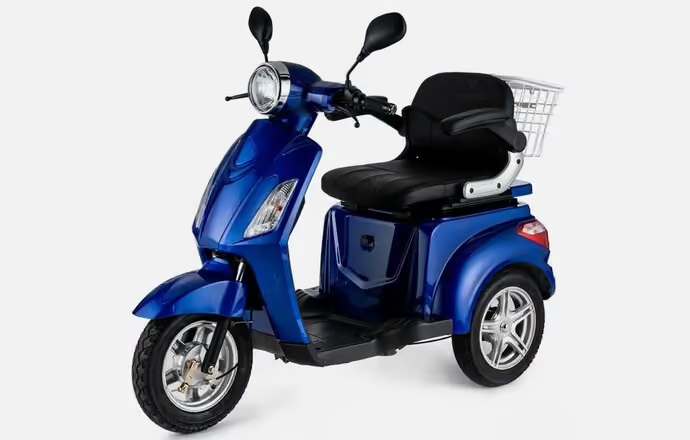
Both types can cost several thousand pounds new, so the secondhand market is busy. Some listings are genuine bargains; others look fine until you take a closer look.
The battery is always worth asking about first as a tired one can make a good scooter unreliable. Sellers should at least be able to describe its current range.
If a scooter struggles on small hills or fades too quickly, it's a sign the battery is coming to the end of its useful life.
The braking system deserves attention too. Mobility scooters don’t rely on bicycle-style cable brakes; they use a system that stops the wheels automatically when you release the throttle. A small electric current keeps the brake open while you’re moving, and when you stop – or the power cuts out – the brake engages instantly. It’s one of the most reassuring safety features of a scooter, but it should feel smooth and predictable. Any dragging sensation, unusual noise or longer stopping distance suggests the brakes need attention.
While giving a used mobility scooter the once over, look out for cracked tyres and hidden rust. Gleaming bodywork might look smart, but it can hide surprises. Mobility scooter chassis can be made from weather-resistant aluminium, but more often they are powdercoated steel. Look out for blistered paint on the chassis as often this is a sign of rust beneath.
Scams are common, particularly on social media. Watch out for prices that seem too good to be true, or sellers who insist on a bank transfer before you’ve had a chance to see the scooter in person. That’s a common feature of scam listings.
Many local mobility shops refurbish scooters professionally and offer warranties, which can make them a safer place to buy used than online marketplaces.
Battery range
Research into mobility scooter use confirms that most journeys are short. A survey found that “most respondents used their scooters three to five times each week and travelled between two and five kilometres from their home.” However, even though the distance that most people travel by mobility is modest, it's important to know your model's range
For example, a compact pavement scooter with a small battery might manage 10–15 miles, while a Class 3 model can reach 30–40 miles between charges. Manufacturers quote their best-case scenario – warm weather, flat ground, light rider, fresh battery – so real-world range is almost always lower.
Another thing that can surprise new riders is how batteries age. They don’t decline in a neat, steady line. AGM batteries – a sealed lead–acid type widely used in mobility scooters – tend to hold their range reasonably well for most of their life and then lose capacity quite suddenly. Lithium batteries fade more gradually, but they too experience a noticeable dip towards the end of their life.
Cold weather, hills, under-inflated tyres and heavier rider weight all shorten range, as does routinely letting a battery run completely flat. AGM replacements usually cost £80-£180 for a pair, depending on capacity, while lithium packs sit anywhere between £300 and £600. Mobility scooter batteries and equipment qualify for VAT relief, so many users pay less at checkout.
Punctures and tyres
Most mobility scooters run on pneumatic (air-filled) tyres because they give more forgiving ride on bumpy surfaces, but they’re also vulnerable to thorns, nails and sharp stones.
Some scooters use solid, puncture-proof tyres to safeguard against punctures. However, they solve one problem but introduce another: without the cushion of an air-filled tyre, the ride can feel harsher. On uneven pavements the vibration can travel straight through the frame, and on longer journeys that can be tiring. It's the reason so many prefer the comfort of air-filled tyres even with the risk of a puncture.
Can you continue a journey with a puncture?
In most cases, no. A mobility scooter will still move but it will be difficult to steer and there is also a real risk of damaging the wheel itself. Do not drive on a flat tyre unless absolutely unavoidable.
The cost of repairing a puncture depends on the tyre size and whether the scooter needs collecting, but most UK mobility shops charge £30–£60 for a straightforward repair. A home call-out, new inner tube or tyre replacement can bring the total to around £80.
ETA mobility scooter insurance includes puncture cover that pays up to £100 towards repair, and our 24/7 breakdown service will recover you and your scooter if you’re stranded. Whether the tyre goes flat outside the shops, or miles from home, help comes to you rather than the other way round.
Security
Unlike bicycles or cars, mobility scooters are not given their own theft category in UK police crime records, so there are no official national statistics. However, former Met Police vehicle-crime specialist Dr Ken German has estimated that more than 23,000 mobility scooters were reported stolen across the UK over an 18-month period. Against an estimated 300,000 scooters in use, that suggests around 5% of all scooters may be stolen each year – a rate broadly comparable with motorcycle theft.
Unfortunately, locking a mobility scooter isn’t as simple as securing a bicycle or a motorbike. Most mobility scooters do not have any usable lock points: the chassis is usually hidden beneath bodywork and wheels do not have suitable gaps for a D-lock or chain to pass through
The safest place to store a mobility scooter is indoors, but that isn’t an option for everyone. At the very least, remove the key from the ignition when you're away from the scooter as this is a condition of most mobility scooter insurance policies and prevents the most opportunistic thefts.
A waterproof cover protects the scooter from rain and keeps it out of sight, while a doorbell camera or small CCTV unit overlooking the storage spot can act as a deterrent and provide evidence if needed. Insurance remains a good failsafe: ETA’s mobility scooter policy covers theft, accidental damage and includes 24/7 breakdown recovery.
Specialist scooters
A small but dedicated corner of the mobility scooter market caters to people who want to wenture beyond tarmac. Machines such as the Tramper boast wider wheelbases, deep-tread tyres and beefier suspension.
The trade-off is size and weight. Off-road models are bulkier, heavier and sit at the higher end of the price spectrum. But for anyone who wants the countryside back within reach, the difference is night and day.
Fast mobility scooters that are "not in a class"
From time to time, you’ll see mobility scooters moving at speeds that look well above the UK’s legal limits. One such example is the Rogue 4 High Speed Mobility Scooter, which is capable of 15mph. These machines are not “invalid carriages” under the Chronically Sick and Disabled Persons Act 1970. Mobility scooters like this are referred to as "not in a class". They have to be registered with DVLA as a quadricycle or trike.
In the UK, mobility scooters fall into two legal categories. Class 2 scooters are limited to 4 mph and are intended for pavement use. Class 3 scooters can travel at up to 8 mph on the road and be registered with the DVLA. Any vehicle that can exceed 8 mph in normal use falls outside these definitions and is not legally a mobility scooter, regardless of how it is marketed.
Canopies & cabin cars
Anyone who uses a mobility scooter regularly knows the weather forecast can decide whether a journey happens at all. It’s why many riders look at canopies oreven fully enclosed cabin cars.
A canopy is the simplest upgrade. The Scooterpac Canopy is a fold-away cover that fits many mainstream scooters. It typically costs £500-£700, though promotions or VAT relief can bring the price down.
Cabin cars are a different proposition entirely. A model such as the Cabin Car Mk2 Plus has proper doors, heating, windscreen wipers, but in the eyes of the law remains a Class 3 mobility scooter. Prices for this type of design usually start around £6,000 and rise with extras such as upgraded batteries or reversing cameras.
Rules and regulations: contradictions and grey areas
Mobility scooters sit under a mixture of legislation and Highway Code guidance, but the information is scattered and can feel inconsistent. This is why users can receive conflicting advice about situations that should be straightforward.
Pavement speed: 4 mph in law, ‘walking pace’ in practice
The Highway Code sets a legal pavement limit of 4 mph, but Class 3 scooters do not have speedometers. Their “tortoise–hare” speed dial isn’t calibrated, and speed varies with slope, surface, battery charge and rider weight. A user has no practical way of knowing whether they are travelling at 4, 5, 6 or 7 mph. In reality, most riders simply judge speed by feel and by matching the flow of pedestrians.
That’s why many councils advise “walking pace” instead.
Why don’t mobility scooters have speedometers?
Mobility scooters were never designed to rely on precise speed measurement. Legally, Class 2 scooters are capped at 4 mph and Class 3 at 8mph, and the responsibility for staying within those limits sits with the design of the scooter, not the user. The motor controller prevents the scooter exceeding its top speed, so a speedometer was never treated as essential.
There is also a usability argument: scooters were designed to be simple to operate, with minimal dashboard clutter. Most riders judge speed by feel, which works well enough for everyday use even if it makes formal speed compliance unrealistic.
The result is a system where riders of Class 3 mobiolity scooters are expected to obey a 4 mph pavement limit without any way to measure their speed.
Road use for Class 2 scooters
Legally, Class 2 scooters should use pavements and may use the road only where no pavement exists. Some councils reiterate this. Others say they should “never” use the road, while a few retailers imply occasional road use is acceptable. The advice is inconsistent, even though the legislation is clear.
DVLA registration for Class 3 scooters
Class 3 scooters must be registered with the DVLA, yet many retailers do not register them or tell customers they need to. Some local authorities describe registration as optional. The result is that many users operate Class 3 scooters on the road without knowing they should be on DVLA records.
Mobility scooters that are not in a class
A mobility scooter is considered not in a class if it can travel faster than 8mph, is wider than 85cm, or weighs more than 150kg (200kg if you need equipment attached to it). This type of mobility scooter must be used on the road only, you’ll need to register it with DVLA and hold a valid driving licence. If its unladen weight exceeds 254kg (excluding any attached equipment), insurance is compulsory.
Shared-use paths
Guidance on shared-use paths varies widely across the UK. Some councils – such as Oxfordshire and Cardiff – welcome mobility scooters on shared pedestrian–cycle routes and treat them as part of the normal flow of non-motorised traffic. Others, like Hertfordshire and Nottinghamshire, say scooters should only use shared routes when signage specifically permits it or discourage their use altogether. Some councils provide only vague guidance.
Because the Highway Code does not address this point at all, the result is contradictory instructions depending on where a user lives or travels.
Trailers and towing
Mobility scooter trailers are sold online, which gives the impression they are legal. They are not. Under the Chronically Sick and Disabled Persons Act 1970, mobility scooters are defined as being constructed or adapted “for the carriage of one person”. Trailers for luggage or passengers fall outside this definition, which makes them unlawful on pavements and roads.
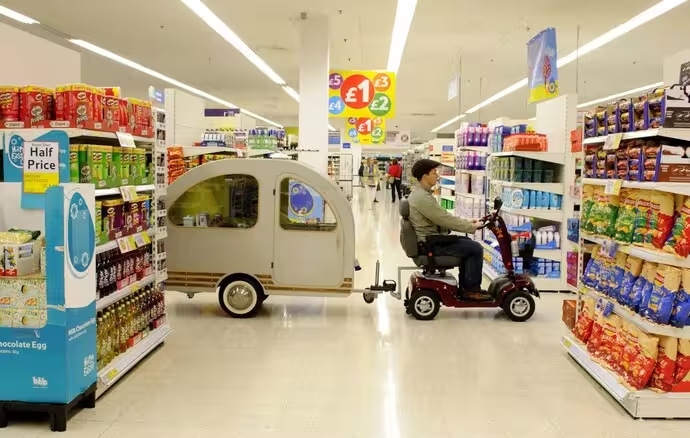
Where mobility scooter law lags
Mobility scooters might be ubiquitous, but they occupy a strange place in law. The Highway Code’s updated hierarchy of road users – designed to protect those most vulnerable – doesn’t mention them, despite the fact that mobility scooter users are at clear risk around traffic. The statistics reflect this: fatalities almost doubled in 2023.
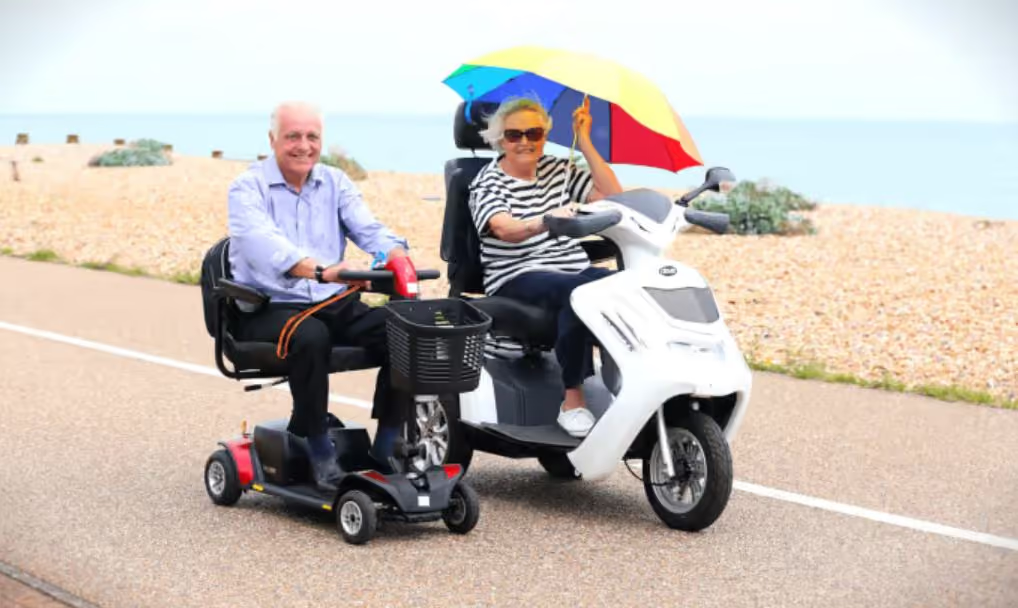
One particularly outdated rule concerns tandem mobility scooters – essentially two–seat versions of standard models. They could be a lifeline for couples where one person can’t operate a scooter alone. Yet they remain unlawful because of a 1970 definition stating that mobility scooters must be “constructed for the carriage of one person”.
It’s an unfortunate oversight, and ETA is gathering case studies from people who would benefit from a change in the law to make tandem mobility scooters legal.
Folding travel scooters
Folding scooters suit people who need something compact enough to lift into a car boot or store in a small hallway. They’re lighter and easier to transport, though the trade-off is they can feel less settled on uneven pavements, especially where slabs have shifted or tree roots have nudged the ground up. For occasional use or fairly smooth routes, they work well.

Why ETA mobility scooter insurance makes everyday life easier
Mobility scooter breakdowns are rarely dramatic,but they are always inconvenient: a battery that runs flat sooner than expected, or a puncture just as the weather turns.
ETA’s mobility scooter insurance is built around the realities of everyday use. Theft and accidental damage are covered, but so are the frustrations like a lost key or a puncture. The breakdown recovery service is particularly useful. If the scooter stops working, you don’t have to coax it home or find a taxi willing to take it. Help comes to you, day or night.
The policy costs £65 per year for a scooter worth up to £3,500, or £90 for two users at the same address.
{{cta-mobility}}
FAQ
Do I need a driving licence?
No. Scooters are intended for people with mobility needs. Class 2 models stay on pavements; Class 3 models may use the road and must be registered.
How far can they travel on one charge?
Usually ranges between 10–25 miles for smaller scooters, and over 30 miles for Class 3 scooters depending on conditions, rider weight and terrain.
How long do batteries last?
One to three years for sealed lead–acid batteries, and longer for lithium versions.
Are mobility scooters waterproof?
They cope with showers, but long term exposure to heavy rain can damage electrics. A cover helps.
Can I take one on public transport?
Airlines often accept folding scooters with advance notice. Train policies vary.
Do they need servicing?
Yes – regular checks on brakes, tyres and batteries, plus an annual service, help keep mobility scooters reliable.
Can you be charged with drink driving on a mobility scooter?
Short answer: yes, you can be penalised – but not under drink-driving laws in the same way as a car driver. Under UK law, mobility scooters are classed as “invalid carriages” under the Chronically Sick and Disabled Persons Act 1970. They are not treated as motor vehicles in the way cars or motorcycles are, which is why you don’t need a driving licence or vehicle insurance to use one.
That said, mobility scooters are still covered by wider road traffic and public-order laws. If someone uses a scooter while drunk and does so dangerously or irresponsibly, they can still face legal consequences. One example is Section 12 of the Licensing Act 1872, which makes it an offence to be “drunk in charge of a carriage” in a public place, including pavements. That offence can carry a fine.
From an insurance perspective, most mobility scooter policies exclude cover if the scooter is being used under the influence of alcohol or drugs.
Quite apart from the legal position, using a mobility scooter while impaired puts others at risk and should be avoided at all cost.
Are retailers obliged to register Class 3 mobility scooters with the DVLA before selling them?
No. Retailers are not legally required to register a Class 3 mobility scooter with the DVLA before selling it. However, the scooter must be registered before it can be used on public roads.
In practice, many reputable dealers will register a new Class 3 scooter on your behalf as a courtesy service, usually as part of the handover process. If they don’t, the responsibility falls to the owner. Registration is straightforward and free, but it does require paperwork.
Both new and second-hand Class 3 scooters need to be registered if they are to be used on the road. Once registration is complete, the DVLA issues a V5C logbook showing the registered keeper. Although registration is mandatory, Class 3 mobility scooters are exempt from vehicle excise duty (VED), so the tax class is recorded as nil. If you’re unsure whether a scooter has already been registered, it’s worth checking before using it on the road – particularly with second-hand purchases.
Can you get penalty points on a driving licence for breaking the law on a mobility scooter?
Mobility scooters are legally classed as “invalid carriages”, not motor vehicles. Because of that, most offences committed while using a mobility scooter do not carry penalty points, even if the person riding the scooter happens to hold a driving licence. However, the position could change if the vehicle was not legally a mobility scooter at all – for example, a high-speed electric trike or quad marketed as a “mobility scooter” but capable of more than 8mph.
Using this type of unregistered vehicle on the road can result in a £100 fixed penalty or prosecution with a fine of up to £1,000, and the police have powers to seize the vehicle. Driving without insurance attracts much heavier sanctions: a £300 fixed penalty, six penalty points on a driving licence, and potentially an unlimited fine or disqualification if the case goes to court, with police also able to seize and destroy the vehicle. Driving without the correct licence can lead to a £100 fixed penalty and three to six penalty points, rising to a fine of up to £1,000 and possible disqualification if prosecuted. Using a vehicle without a valid MOT carries a £100 fixed penalty or a fine of up to £1,000 in court, and can also invalidate insurance if an MOT is legally required.
How common are mobility scooter battery fires in the UK?
Official fire records combine mobility scooters with other battery-powered vehicles such as e-bikes and e-scooters, and reporting is voluntary, so there’s no exact published count for scooters alone. In the most recent data from the Office for Product Safety and Standards, of 211 reported battery-related fires involving e-bikes and e-scooters, one was identified as involving a mobility scooter. Broader fire data shows lithium-ion battery fires for all micromobility devices have risen sharply in recent years, but mobility-scooter fires remain rare in the available statistics.
Information correct at time of publication.
Leave us a comment
